Key Takeaways
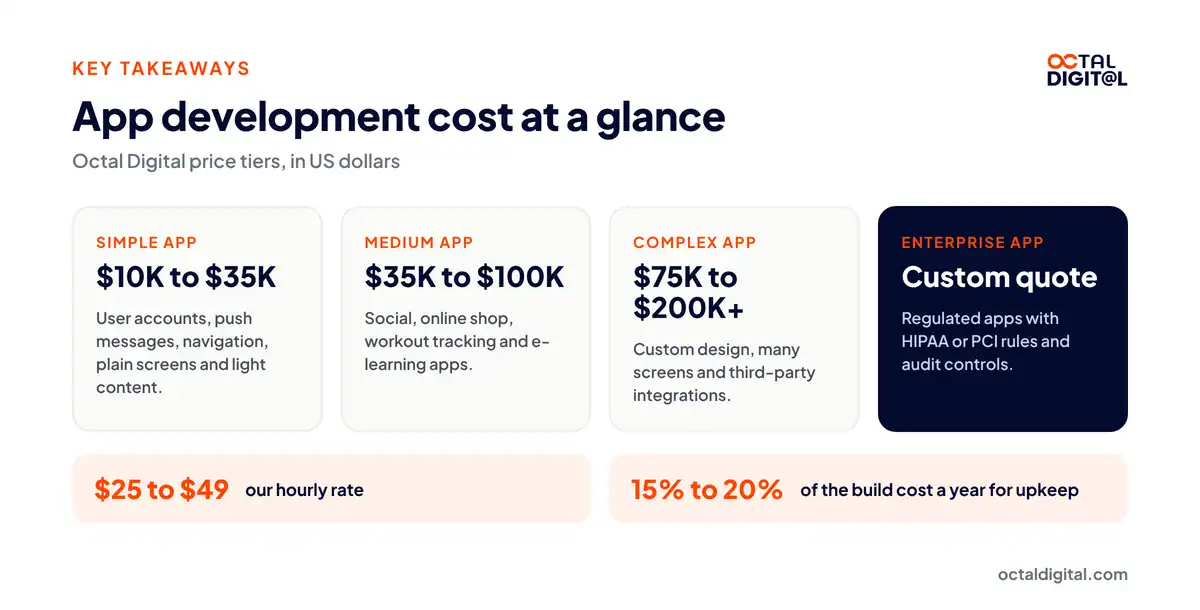
- App development cost: About $10,000 to $200,000+, set by scope and hourly rate
- Simple app: $10,000 to $35,000
- Medium app: $35,000 to $100,000
- Complex app: $75,000 to $200,000+
- Enterprise or regulated app: Custom quote
- Market average: About $49,000 to $135,000 for a medium app across nine top-ranking guides
- Upkeep: Plan 15% to 20% of your build cost each year
If you’ve ever thought about launching an app, you’ve probably asked, “How much does it cost to make an app?”
At Octal Digital, we build apps for a living, so we can walk you through this tricky question.
In this guide, we’ll go over the real app development cost and dig into factors that drive the price, things to weigh before jumping into app development, what each phase and platform costs, and much more.
Whether someone is coding an app on their own or hiring a full design/development agency to make it for them, overspending is always a risk.
This shouldn’t keep you from launching an app but act as a reminder that an app build is a real investment. To see your budget hold, you need to plan early and carefully, get real quotes, and work to scope something that will actually serve early users by solving one main problem.
How Much Does It Cost to Make an App?
With us, the app development cost is somewhere between $10,000 and $200,000. But, it can climb above $200,000 for regulated or enterprise apps.
| App type | Octal Digital price | Market average (9 top guides) |
|---|---|---|
| Simple app | $10,000 to $35,000 | $12,200 to $50,000 |
| Medium app | $35,000 to $100,000 | $48,800 to $135,000 |
| Complex app | $75,000 to $200,000+ | $128,900 to $314,300 |
| Enterprise or regulated app | Custom quote | Varies by rules |
Your app development cost comes down to the amount of work your developers must do and the hourly rate they charge. The catch is, the hours may run from a few hundred to a few thousand, and the rates may shift depending on the team’s location and skill. That’s why it’s hard to pin down the price right away. But, don’t panic. In this article, we’ll break down the question “How much does it cost to make an app?” step by step so you can set your budget.
We’ve roughly priced three groups of apps by their difficulty to show how the typical cost to make an app is worked out (at our hourly rates of $25 to $49).
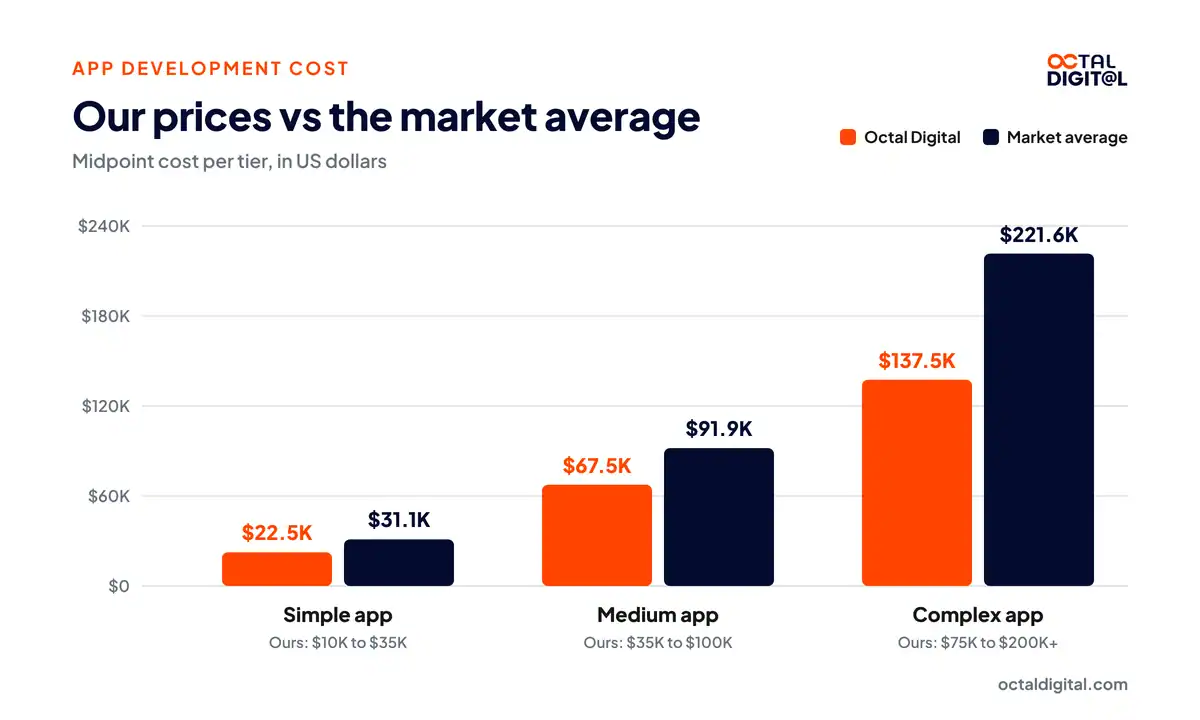
So, giving a short answer on what it costs to build an app: a simple application will cost around $31,000 on the market, while mid-level and complex apps will run around $92,000 and $222,000 or higher. But, if you call agencies from several cities, you’ll get different quotes. This comes from the big gaps in app developer hourly rates based on the agency’s location and size.
Let’s look at how our prices compare with the market average from nine top-ranking guides.
As you can notice the price is changing. That’s why it’s always better to ask quotes from the app vendor to get an exact estimate for your app idea.
App Development Cost by Complexity
Simple App Development Cost
These are apps with a small set of functionality, like user accounts, push messages, navigation, plain user interface, and light content display. The build period for such apps is the shortest of the three. Our simple app development price is about $10,000 to $35,000.
Medium App Development Cost
Medium apps are harder to make as they contain more advanced functionality, interactive parts, and a lot of content. The examples of such products are social media apps, online shop apps, workout tracking apps, and e-learning apps. Our mobile app development costs go between $35,000 and $100,000. When it comes to booking app development cost, your budget may land in a close range but often hinges on calendar sync, API integrations, and payment processing complexity.
Complex App Development Cost
Complex applications come with custom design, many screens, third-party integrations, hence showing a high degree of complexity. For instance, when a taxi company decides to switch from a ready-made white-label app to a custom-made one. In this case, the cost gets higher. Our costs of building such an app run from $75,000 to $200,000+, and regulated apps get a custom quote.
But, what makes an app complex? Mostly, the feature set. To make it clear, we’ve drawn the image below to show what your money covers at each complexity level.
What Shapes App Complexity?
To find the answer for the question: ‘How much does it cost to make an app?’, you should figure out how complex the app you plan to build is. Several things shape the complexity of an app project.
Functionality and number & depth of built features are the biggest price drivers in app development. Screens, buttons, forms involved, the volume of logic needed matter a lot. Basically, telemedicine software development can’t cost the same as building an app like Uber.
Depending on the depth of solutions, developers take different hours to build the requested features. For example, a complex system needs the use of outside APIs or coding from scratch. Simpler apps, in turn, require stock tools and use native features.
Apart from basic core functionality, many apps need integration with outside services, such as card payment gateways, maps, or APIs to improve user experience. Adding such services impacts the price to get an app built. The fee for third-party services begins at free tiers (for simple apps) and climbs to large monthly bills for mid-size and large systems.
How to Estimate the Cost to Build an App
In practice, app development cost can be worked out from hours times the hourly rate. Of course, you could make an app for close to nothing by coding it yourself at night. Or, if you’re a big retail brand, you might pour millions in an app when it is a central part of your company.
But if you’re neither of those groups, then this is the math your app’s quote will likely follow. And if you’d like to be more exact, a quick sum for a custom designed/built app is 600 hours x $40 = $24,000 for an MVP.
The reality is that some app MVPs sit near this sum, though they can be bigger or smaller based on a few other factors. We’ll get to these factors in a moment.
The main factor that shapes your app development cost is the number of hours in the scope. A small app will sit far lower on the price scale, while a feature-heavy app will end up pricier. That’s because complexity eats more time, raising developer hours and, in turn, the total cost.
We set the price of an app by the kind of project you need. A full build means making your app from zero, while an hourly team adds to work that’s already underway, and both carry different pricing models. Across this guide, we’ve shared general prices and ranges based on our tiers and market data. However, we haven’t been too exact, as every agency will set its own fees and prices.
We can share what we bill here at Octal Digital. So, before you compare quotes, here’s a quick look at how our rates work. In general, expect to pay $25 to $49 an hour on an Octal Digital app development project. The rate could be lower or higher, based on the team your app needs.
Get a real number for your app
Send us your feature list and we’ll come back with hours, rate and a cost range.
App Development Cost by Phase
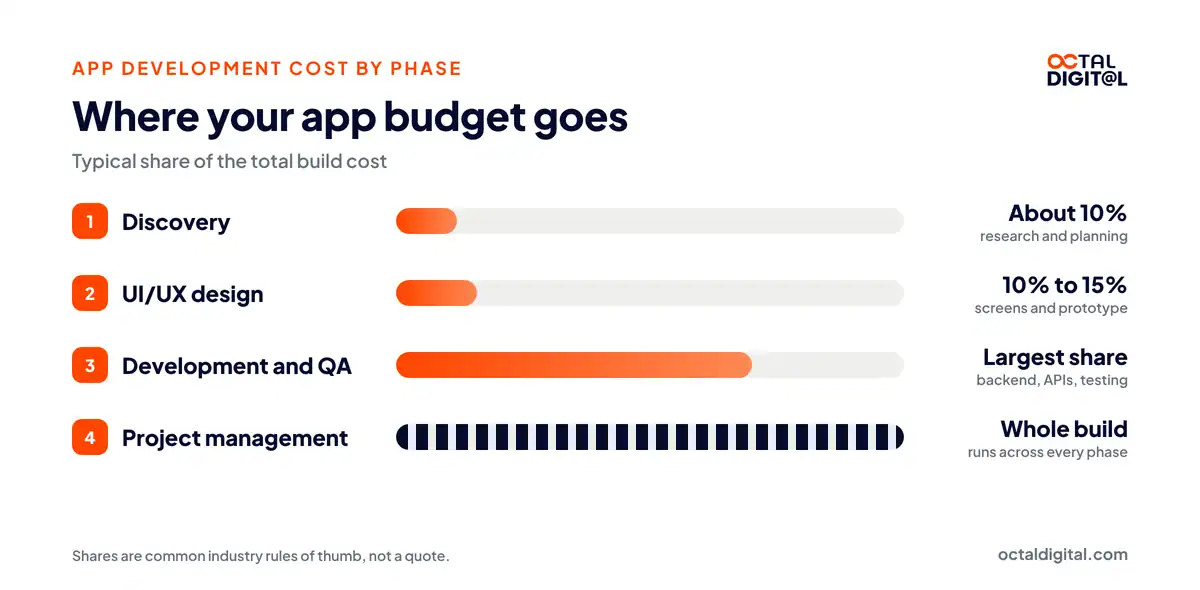
The cost of building mobile application is built up from build phases and extra components. Adding them up gives you a rough price. In this part, we’ll show the build part and what each phase costs. The extra cost items will be covered in the part after this.
Discovery Phase Cost
The Discovery phase (also called research and planning stage) is a key step of the mobile app development process to define tech and business needs before moving on to development costs. This phase usually needs the input of business analysts, product designers, tech leads, and a project manager. The team reviews the market and rivals, checks your business goals, and user demands.
A common practice is to set aside 10% of your total app budget for the Discovery phase.
Based on the findings, we write the requirements document, break down and detail the features, fix the timeline, plus prepare a cost estimate to build a mobile app. Discovery phase cost in mobile app budgets grows with the size of the app. The planning and research takes longer for bigger apps.
UI/UX Design Cost
It’s hardly possible to make a great product without a skilled designer who’d provide UI/UX design work. This phase is about the mapping of how the app will work. The design team sets the main user scenarios, draws the screens and functionality, and maps the user journey.
The design phase often makes up 10-15% of the full price.
The design team also builds a clickable prototype, so you can test how the app will look and feel and what it can do before coding begins. The design budget in your app price starts small and can grow fast for big apps. The cost hinges on the count of screens to be drawn, and app logic complexity.
Development and Testing Cost
How much does the coding stage cost? As you’ve noticed, many things can move the price either way.
The coding stage needs close attention from your app team as it’s the core and most costly phase of app building. It covers the building of the backend of the app, API connections, and turning the approved design into a real product. The more complex the features are, the more hours it will need from developers to build and test them, leading to higher costs.
Your app budget also includes the stage of QA and app release. The QA testers run many tests to make sure the app works smoothly and matches the original project’s goals. Once the app passes QA, it is pushed to the live environment and released to real users.
Project Management Cost
Project managers organize the work of the whole team and check that the app will be ready on time and meet all the requirements. Because of that, the right management style has a big effect on mobile app development costs.
App Development Cost by Platform
The choice of target platforms for your app will also affect the cost of making an app. Here’s a look at the typical app price for each type of OS platform.
Android App Development Cost
An app built for Android is a phone app made to run on Google’s Android OS and aims to work with the device’s hardware. The cost of Android app development follows the tiers above, based on the app’s feature set.
iOS App Development Cost
iOS apps are built to run on Apple devices, like iPhones, iPads, and Apple Watches. These devices run on Apple’s own operating systems, whose apps are coded in Swift or Objective-C. Your iOS app development cost falls within the same tiers, based on app’s scope and developers’ rates.
Building for iOS or Android costs roughly the same. The price gap isn’t big. But, if your app must cover two or more platforms, be ready to spend more money on the build or pick cross-platform app development to trim the price.
Cross-Platform App Development Cost
Cross-platform apps, made with Flutter or React Native, run well across platforms by relying on one shared codebase, thus, lowering the app price. Typically, a Flutter app costs less than building two separate native solutions. By making cross-platform apps, you can reduce what it costs to build mobile apps by a good margin.
Web App Development Cost
The web version of an app is made to work across web browsers on many devices and costs less to build at first compared to native apps. Web app development cost starts low for a simple tool and can climb past $200,000 for a full-featured platform backed with ongoing hosting and upkeep charges.
App Developer Rates: In-House, Onshore and Offshore Teams
Now that you know the costs that go into your app build, let’s look at your choices when hiring an app developer. After all, the market has many kinds of app studios, each with its own rates, workflows, and trade-offs to weigh.
Building an In-House Team
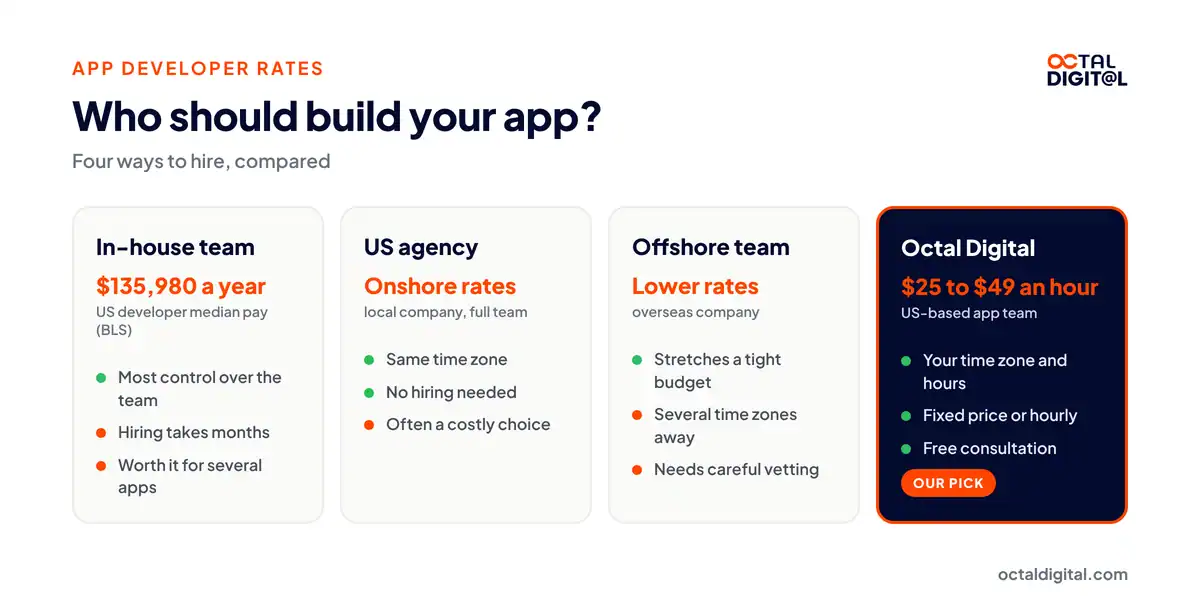
The first route you can take when building mobile app products is to hire an in-house team. On first look, this might look like the best choice. After all, you’ll get more say over how the app comes together. You can hand-pick the people on your app and get more say over the budget.
If these perks matter to you, this could be the right fit for your app build. However, it’s worth noting that this route comes with a few problems.
Hiring the people your app needs might be harder than you expect. The average founder isn’t sure how many people it takes to make an app, never mind the exact roles to fill during the build.
Also, it’s likely not worth the cost unless you’re planning on running several apps, since US software developers earned a median $135,980 a year in May 2025. Finding talent, hiring staff, setting up and running a crew, and then the real build cycle can eat up months or even years to finish.
In the end, you may see that the app took far more (time and cash) than you planned for a single product. So, in most cases, this route may not be the smartest, except when you want a long-term product team.
Outsourcing to a US Agency
That’s why the second choice, outsourcing, is so popular. You don’t need to hire anyone; instead, you work with an app agency that has already built its own skilled team of developers.
Hiring a local app company to run the whole build process can be a smart option. This is called onshore development.
Onshore work can be (and many times is) a costly choice.
Outsourcing Overseas
Working with an offshore app development company is another usual option. This is when you pick a foreign team to make your app for you. This has a few perks, provided you know how to vet the best offshore partner.
Offshoring often means working with coders in countries a long way from your own, possibly spanning several time zones. One key upside of taking this route: it can be cheaper to hire coders in other countries than ones in your own, which can be handy if you’re working with a budget that you need to stretch.
A third version is a US-based development team with lower rates, or working with app developers in your own time zone with shared office hours. This kind of team also tends to have the benefit of easier calls and clearer contracts between clients and app teams.
This kind of setup is what we do at Octal Digital with our US-based app team and fixed price or hourly options. Our hourly rate of $25 to $49 makes us a good fit for startups in the United States and even growing small businesses due to similar hours and lower rates.
Curious about hiring a US-based team? Learn how our mobile app development company works on this page!
US-based app team, without US agency rates
Our developers work at $25 to $49 an hour, on a fixed price or hourly, your choice.
How Much Do Popular App Types Cost?
Typical costs for four app types you surely know: a real estate app like Zillow would cost around $35,000 to $100,000 for a smaller first version, a taxi app sits around $75,000 to $200,000+, a food delivery app sits around $35,000 to $200,000+, and an AI app would generally cost around $35,000 to $200,000+. These are tier figures, so they aren’t quotes. Still, based on our tiers, we think these numbers sit within a fair range.
Real Estate App
Zillow’s app is a mix of an online listing site and a home search app. Their home buying app includes features like:
- Letting agents add photos and list their homes
- Search so buyers can find homes to tour
- A saved list for buyers to keep homes they like
- A tour request flow that includes open slots, agent contact, and showing details
A smaller real estate app like this would cost around $35,000 to $100,000 to build.
Taxi or Ride-Hailing App
A taxi app needs a rider app plus a driver app, which likely puts most of the money into building the first version of the product. The taxi app is quite complex. It has detailed features like maps, matching riders with drivers, taking payments, estimating fares, etc. It’s also an app that keeps growing its feature list each year, making it a bigger investment.
Food Delivery App
DoorDash is among the most used food delivery apps in the US, and it’s earned that spot with a fairly simple idea. It’s a strong case of an app that turns a simple idea into three apps with smart design and engineering.
When it comes to food delivery, most of the hard work is under the hood. The menu screen is basic, while the dispatch logic that goes into it is complex and likely always changing.
A food delivery app usually needs a medium to complex budget to be built. It also likely takes hundreds of hours of testing before the app is opened to the public.
AI App
An AI app, unlike the others here, is priced by its model usage too. An app like this will usually cost anywhere from the medium to complex tier to build. And like a real estate app, it relies on data from its users to fill the app with value. This brings ongoing model and server bills, which is why planning usage costs is so important.
Hidden and Ongoing App Development Costs
Beyond functionality, design, and device integrations, there are extra costs to bear in mind when you plan the budget of app development. Let’s list them.
App Administration
The admin panel is surely a really handy tool for handling app content, users and stats. There are ways to adapt ready admin panel templates to fit your needs, but a solid one is hard to find. So it pays to build a proper panel to suit your business needs.
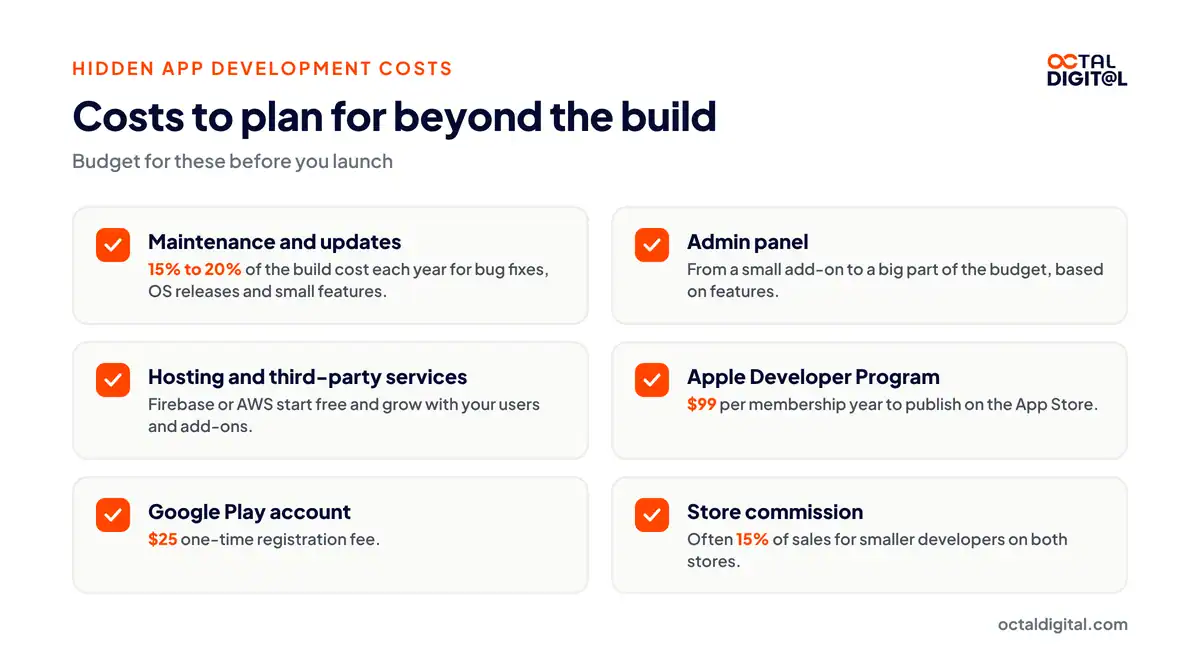
Based on the app’s size and its functionality, making a custom admin panel can range from a small add-on for a simple setup to a big chunk of the budget for a feature-rich back office.
Third-Party Services and Hosting
Apart from the sum paid to a developer for the build, there are also charges for outside (3rd-party) tools. The more add-ons you want to plug in (e.g., push alerts, in-app chat, payment processing, maps, etc.), the larger will be the monthly bill of your mobile app.
Roughly, the running costs, like cloud hosting on Firebase or AWS, start free and grow with your users. The bill will hinge on the count of these services and the traffic of each integration in your app.
Support and Updates
Another point to weigh is what it costs to maintain an app. It usually covers bug fixing, adding small features, prepping for each new iOS or Android release, and so on. It also hinges on how many updates you’d like to ship per year and how big they are. App upkeep is a must, even when you have no plans for growth and adding new screens to the app. Your upkeep cost will grow as your app becomes more complex over time.
It’s a standard practice to set aside 15% to 20% of your original app build costs for maintenance each year.
App Store Fees
You should also plan for setting aside a sum for store accounts to publish the mobile app and reach first users. When it comes to the app store budget, the sum is small. Apple charges $99 per membership year for its Developer Program. While Google Play asks for a $25 one-time fee to open an account.
Speaking generally, both stores also keep a cut of sales, often 15% for smaller developers.
| Cost | Typical amount |
|---|---|
| Apple Developer Program | $99 a year |
| Google Play developer account | $25 one time |
| Store commission for smaller developers | Often 15% of sales |
| Maintenance and updates | 15% to 20% of the build cost a year |
| Hosting and third-party services | Free tiers at first, then grows with users |
How to Reduce App Development Costs
When asking yourself how to cut the cost to create an app, features and scope are some of the biggest things to bear in mind.
Try to see each feature you will add to your app as a separate project that your app team will take on. They’ll need to work out where the feature fits into the app, decide how to code it, design a screen for it, connect it with the other screens and data, and so on.
For this reason, keeping your app lean can do a lot for lowering app development costs (and possibly help you learn from early users). The fewer features you ask for, the lower spend your app will need upfront, and in most cases, the quicker the build will go.
If you’re on a tight budget, consider only keeping your must-have features. Say you plan to build five features, but just three are needed for your app to do its main job. You might release the app with three as an MVP and ship features four and five later in updates once the idea is proven.
Keep in mind that the cost will jump if you add cutting-edge features, like AI features, AR, or wearable support. These are useful features to put in an app, but since they are newer, niche, or need special skills, they cost more to build.
Just like features, the more custom your screens look, the longer they will take to build and the more money they will need. Luckily, clean designs are common and easy for users, so there’s no need to overbuild your app’s visuals, and it’s often smarter to keep things plain. Using standard iOS and Android components for the visual parts of your app is a simple way to control costs. It is also smart to reuse a UI kit with your developers, who can adjust it to match your app’s features.
Cross-platform builds can be more budget-friendly and may also pay off when your users are split across both platforms.
How to Choose an App Development Partner
See our tips on how to choose an app development company that can turn your first idea into a real product.
Fit the Budget
Although price should never be the main criteria when picking a mobile app development agency, let’s be honest: the budget is key, especially for a startup. Still, we know that striking the right mix between quality and price is never simple. First of all, step back and look at the profile of your business. It will likely show whether you need to hire a big firm, a mid-sized app studio, or a solo freelancer, and it will help you set the rate.
When setting the budget, try to always think about the long term. The agency that says it’s the cheapest in town might look tempting, but carries the risk of poor code.
Don’t fall for a low quote: make sure that your app won’t turn into a costly rebuild later on. Trust us: when you’re just starting out, you don’t have the extra budget to burn on second rounds. Keep in mind that a common cause of budget overruns is slow delivery and endless rework.
For instance, at Octal Digital we share our hourly rate up front. It is set by the skills of the developers on your project. Simply put, each extra feature adds more cost. The right app partner should give you a clear cost estimate based on the project’s needs. They should also help you plan the spending for the next build stages.
Plan for Support
Launching an app is just the start. If you want more users, at some point you will need to update it. It’s normal that you may want to add new features, or just repair whatever is not running well.
It may also turn out that you choose to continue work on your app in-house. The right app partner should be fine with this. Check that your app partner will give you ongoing support and quick help on changes. Also, be sure to settle all the details: terms, rates, and how much upkeep is covered.
Read the Contract
Last of all, be sure to confirm you will own the finished code and get a written IP assignment. It should say clearly in the contract that the designs, content, and app source code belong to you. Also, a reliable app development partner should not lock you in just to keep your app live but leave you free to switch teams once you need to.
Talk to the team before you sign anything
Book a free consultation and get a second look at your app quote or contract.
How Long Does It Take to Build an App?
It all hinges on the amount of screens and features that have to be coded, as our guide on how long it takes to build an app explains. Inside our Discovery phase we pull together a project timeline. Depending when you okay the timeline it can be as short as a few weeks for small apps. Bigger apps can need many months. Almost all apps will also see regular updates and upkeep to tune the app over time based on reviews and user needs.
So, What Will Your App Cost? It Depends on Your Scope, Platforms, and Team
As you can see, a lot feeds into the reply to the question, “What will my app development cost be?”
One thing we can say for sure, though, is that a tight scope saves you money. If you’re hunting for a fair price and an app to fit your goals and budget, we’re ready to help! Get in touch with the team at Octal Digital today and walk us through your app!
FAQs
How much does an app cost?
We can provide you a clear cost estimate with our Discovery phase. The Discovery phase allows us to go over your app idea with you to make it a clear plan. When this first phase is complete we hand over a requirements document and wireframes together with a project plan and a full project cost. A mobile app’s price rests on the features in the app, the tech stack and the number of target platforms. It’s common for a simple app to start at $10,000 with us and $35,000 for a medium app. It’s not unusual for our clients to want several pieces from Octal Digital including the app, a website, a web portal, an admin panel, a database and APIs that can push the total to $75,000 to $200,000+.
Can I build an app for free?
No-code tools let you design and launch simple apps and prototypes for free or a small monthly fee. Check the plan limits before you start building. As a test tool, a no-code app can quickly go live in as little as a few days. Custom apps that grow bigger and need logins, payments and store listings still need paid developers and store fees.
How much does it cost to make an app yourself?
Your DIY app cost mostly rests on the planned features of your app. You can pick a no-code tool or a framework that works for your skills now and later on. Some solo apps people launch are on Firebase which offers a free starter plan for hosting, login and a database, so your main fixed costs are the $99 yearly Apple fee and the $25 Google Play fee.
How much does it cost to maintain an app?
App maintenance is the work of keeping an app current and stable as well as running fast, and a common budget is 15% to 20% of your build cost a year. App maintenance includes tasks like checking all the screens in your app are working, regularly updating for new OS releases, and fixing any new bugs. It also covers more general upkeep work like backing up your data often and tracking your app’s speed.
How much does it cost to put an app on the App Store or Google Play?
Generally speaking, Apple charges $99 every membership year to put your app on the App Store. If you plan to sell on Android, Google Play asks for a $25 one-time fee to open a developer account. Both stores also keep a share of paid apps and in-app sales, and that share is often 15% for small developers.
Does Google take 30% of app revenue?
Not on most small apps, as Google’s fee on the first $1 million of yearly earnings is 15%. In the US, that is now split into a 10% service fee and a 5% billing fee.
Is cross-platform cheaper than native?
Usually yes. Depending on your build type native or cross-platform, you can have unique codebases for each platform or a shared codebase that will allow developers to “port” your cross-platform app to your target devices. Because iOS apps don’t run on Android and vice-versa, native builds rely on different systems, coding languages and screen sizes, which need extra coding for the apps to display properly on each platform. Our team can help you choose what the right option for your app and budget would be.
How much does it cost to hire an app developer?
Our team builds iOS and Android apps at $25 to $49 an hour, while a full-time US developer earned a median $135,980 a year in May 2025. Freelancers and agencies each charge their own rates, so contact us any time to talk through your app needs.