Key Takeaways
1 min summary- Lyft is widely seen as the closest match to Uber, with service in over 650 US and Canada cities.
- Prices change by trip, so check both apps before you book, since neither is cheaper every time.
- With Obi, the app finds the cheapest ride based on live prices from Uber, Curb, Waymo, and more.
- Curb has licensed taxi drivers in more than 100 cities and usually no app surge pricing on rides.
- Like Wridz and Empower, some newer apps give drivers more of the fare, so riders can pay less in the cities they serve.
- Waymo is available for public riders in 14 US cities as a fully driverless robotaxi service, with more cities added this year.
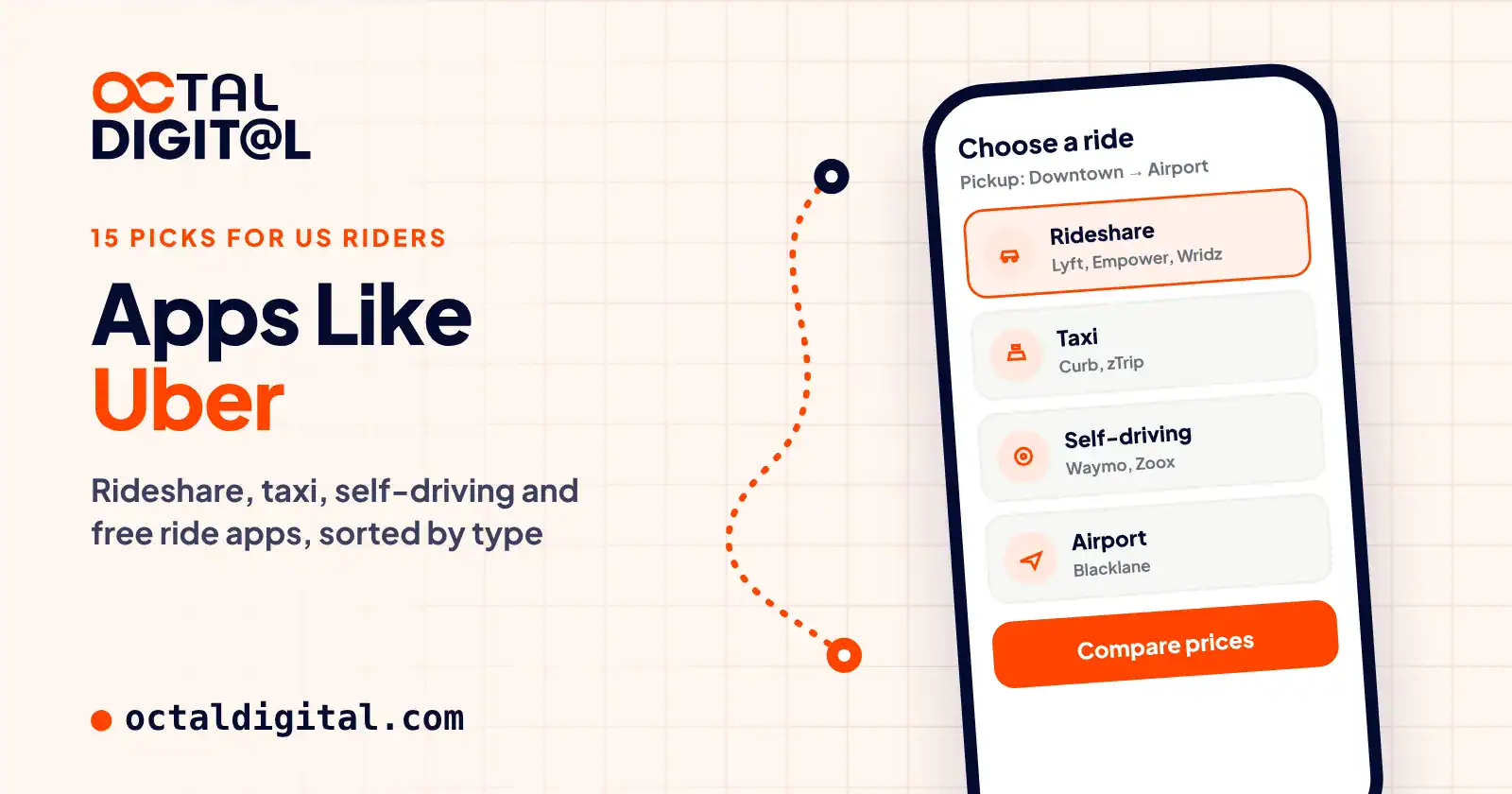
As more and more people head out for airport runs, late dinners and work trips, they’re naturally opening ride-hailing apps like Uber to get places, ideally in hope of quick rides. But there’s a catch: Uber and Lyft are both coping with a lot of surge pricing. It’s not exactly shocking, given the fact that demand jumps at busy hours in most cities, and both apps are notoriously quick to raise fares, to put it mildly.
In the last few years, a new crop of apps started by drivers, taxi firms and tech companies began to offer rides that let riders skip the surge and let drivers keep more of each fare. Now, in a bid to win riders, these apps are offering lower prices and flat fares, but, as riders on Reddit often point out, these apps don’t work in every city or at every hour. As for how riders get affected, the gap also means there’s a big difference in which app is the best pick from one city to the next.
All that said, there are surely good reasons to look past both Uber and Lyft, if you’re put off by the high prices, the long waits, or you’re just tired of seeing no cars nearby late at night. But then, what should you do once you need low-cost rides and can’t find a driver? Here are some options beyond the largest ride-hailing apps, sorted by the kind of ride you need.
Uber Alternatives at a Glance
Lyft is the closest match to Uber for rideshare service across the US and parts of Canada. Still, there are lots of Uber alternatives offering cheaper, more local, and driverless ride options.
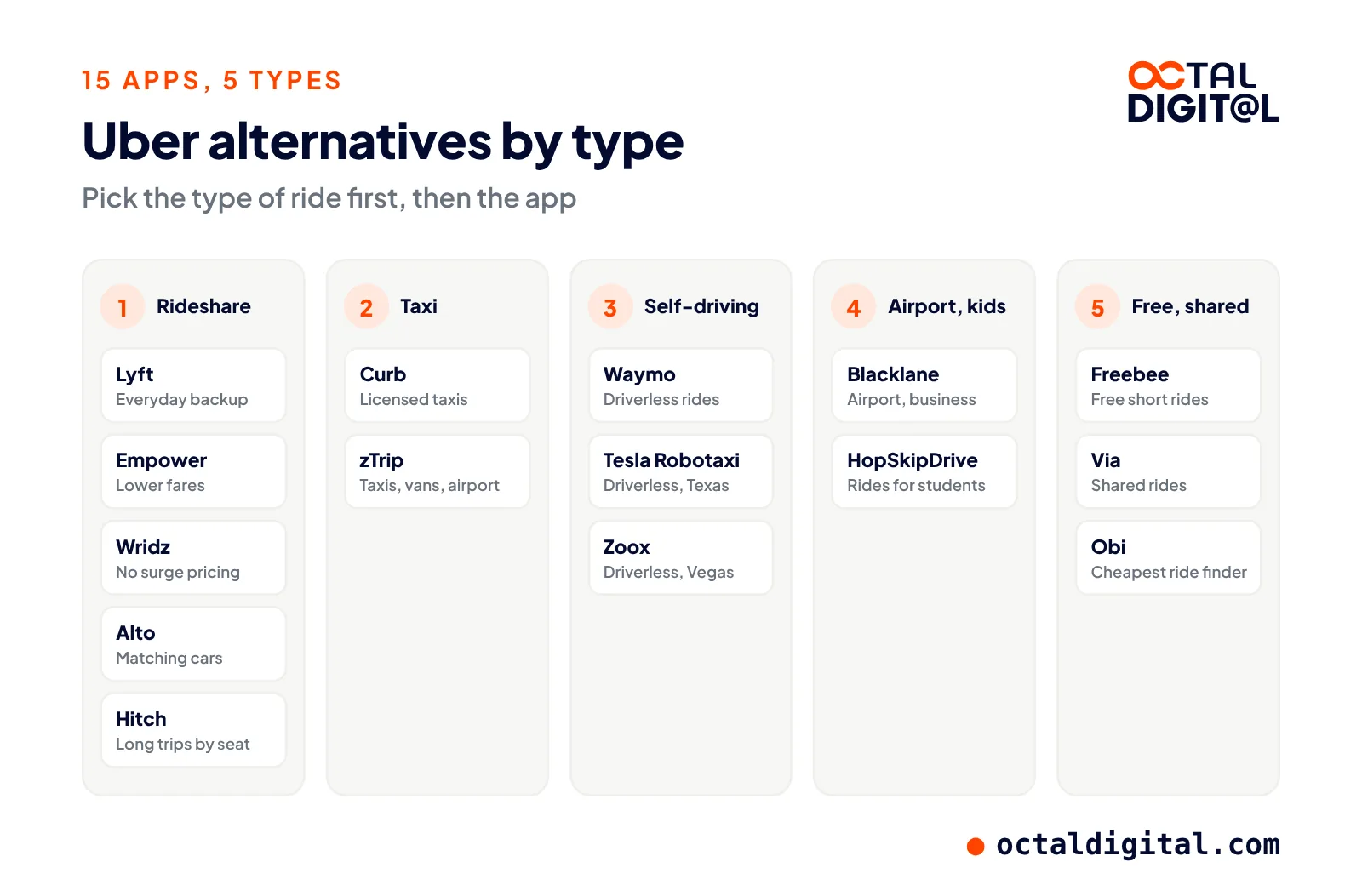
In the US, you can use Empower, Wridz, Curb, Waymo, and Hitch for your ride needs. Elsewhere, Bolt, Grab, FREENOW, DiDi, and Ola are other good rideshare options.
| App | Best for |
|---|---|
| Lyft | A second everyday app |
| Empower | Lower fares |
| Wridz | No surge pricing |
| Alto | Clean, matching cars |
| Hitch | Long trips by the seat |
| Curb | Licensed taxis |
| zTrip | Taxis, vans, airport rides |
| Waymo | Driverless rides |
| Tesla Robotaxi | Driverless rides in Texas |
| Zoox | Driverless rides in Las Vegas |
| Blacklane | Airport and business trips |
| HopSkipDrive | Rides for students |
| Freebee | Free short rides |
| Via | Cheap shared rides |
| Obi | Finding the cheapest ride |
Rideshare Apps Like Uber and Lyft
If you’re tired of Uber’s prices, sudden price surges, long waits at night, and low driver pay, these apps might be what you want in rideshare services.
1. Lyft
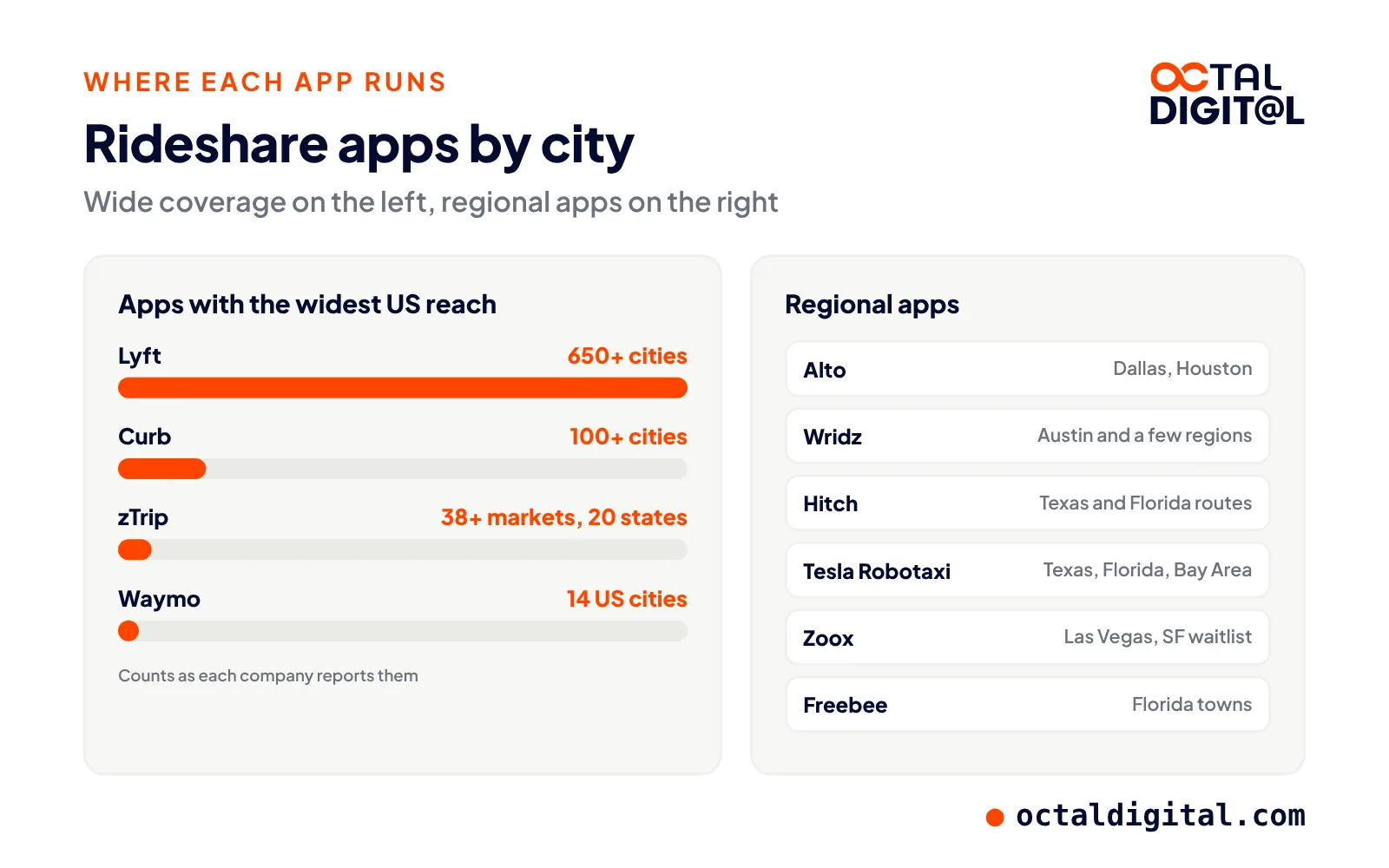
With service in over 650 cities, Lyft is the most common ridesharing app to try after Uber in the US. Its home base is San Francisco, and it runs in most big cities in the US and in parts of Canada.
Lyft isn’t limited to standard car rides. It also offers bigger XL cars, black car rides, wait-and-save rides, and bike rentals in some cities.
Lyft earns money by taking a cut from each ride booked in its app. The pricing isn’t fixed but changes and is based on demand and drivers nearby.
The top thing about Lyft is that it works in most US cities Uber does. So if you want a second app that you can count on in most cities, Lyft is your best choice (and if you’d like to check prices before you book, keeping both apps on your phone is a great habit).
One downside to Lyft is that it isn’t always cheaper than Uber.
2. Empower
Empower is a low-cost rideshare company that runs an app to link its drivers with riders. What makes it different from other rideshare services is its “drivers set the price” model.
Unlike other “one app sets the fare” options, Empower lets drivers in your area pick their own rates and keep what you pay them. Its app then shows you nearby drivers and their rates before you book.
The app lets you favorite drivers you like and request them for future rides. You can also limit requests to drivers of the same gender, if that makes you feel safer.
Compared with both Uber and Lyft, Empower says riders pay drivers about 20% less on average. For example, in New York City, a May 2026 report from the price app Obi found Empower nearly 30% cheaper, while the city itself is suing to ban the app for running without a TLC license.
3. Hitch
Hitch is a rideshare firm that focuses on city-to-city travel. What makes it stand out from other rideshare apps is that it mainly provides long-distance rides.
This means you don’t have to book a pricey Uber for a three-hour drive because the prices are set per seat when you book your trip.
The Hitch app allows you to choose your ride with options for shared seats, standby seats, a private car, an XL car, and traveling pets. If you’re on a budget, it also lets you pick a shared or standby seat so that the price stays as low as possible.
With routes such as Dallas to Austin, Houston to Austin and Miami to Tampa, and seats starting at $15, you can rest easy that many big trips in Texas and Florida are covered.
4. Wridz
Wridz is a newer rideshare service that has one of the better rideshare deals for drivers.
The firm makes money by charging drivers a monthly subscription without commissions.
This means the driver gets to keep nearly all of the fare, with only airport fees and some insurance taken out, as well as any tips.
The main drawback for Wridz is that it only runs in Austin and a small group of other regions. However, if that’s where you’re based or are traveling, it’s one of the most driver-friendly ridesharing options available, and it skips surge pricing too.
5. Alto
Unlike most other Uber options in this list, Alto is a rideshare service that owns its fleet of cars and recently upgraded it with all-electric Kia EV9 SUVs.
This means that you don’t have to worry about a dirty back seat or a car that doesn’t match the photo in the app.
You can use Alto in Dallas and Houston.
Taxi Apps That Work Like Uber
6. Curb
Curb is offered in more than 100 cities: New York, Chicago, Boston, Los Angeles, Miami, and San Francisco, plus New Orleans. Unlike Uber or Lyft, which lean heavily on private drivers, Curb lets you book (and pay for) a real licensed taxi from your smartphone. As with classic taxi services, Curb’s rides come from local cab fleets, so you don’t usually need to worry about surge fares as you would with other rideshare apps (though the app will show an upfront fare when you book from your phone). In certain cities, you can also use the app to book a taxi ride ahead of time with Ride Later, and you can tap the “Pair & Pay” feature when you’re already in a cab you flagged on the street.
7. zTrip
zTrip is available in more than 38 markets including cities in 20 states. It’s careful to work with local taxi fleets in regular, licensed taxi cabs, with wheelchair-accessible vans and black cars as well. zTrip also has shuttles for groups and an airport service, which helps when you need more than one car or an early flight.
Tell us your idea. We reply with a free consultation, a written scope and a cost range for rider, driver and admin apps.
- A written scope and cost range
- Fixed price or hourly, your choice
- 5.0 rating from 250+ client reviews
Self-Driving Ride Apps
8. Waymo
This newer player on the rideshare landscape removes all of its drivers from the car, which is what both Uber and Lyft have been chasing at all costs, making it the robotaxi riders can’t get from the big rideshare apps in most cities. All of the cars go through testing with Waymo, and they collect you in electric vehicles run by Waymo and monitored by its team, so you know what you’re getting when you order a ride. Due to this, prices can run higher than the other apps and waits may be longer (cars only run inside set service areas), but you can check the fare in the app to see the price, pickup time, and route first. The app is now available for public rides in Phoenix, San Francisco, Los Angeles, Miami and Orlando, with Uber-booked rides in Atlanta and Austin as well, though they still plan to grow into more cities, and Waymo now counts 14 in total.
9. Tesla Robotaxi
If you’re living in Texas or Florida, Tesla Robotaxi might be one of your top options for driverless rides. The service is geared primarily toward those two states, but you can also use it as a regular rider in the Bay Area too, while the app pulls rides from a fleet of Model Y cars, so you can view the pickup time, price, and route without having to call a driver. Bonus: In Dallas and Houston, the rides launched with no one in the driver’s seat. In California’s Bay Area, Tesla is only available with a safety driver, so while you can book a ride on the Robotaxi app, you’ll actually be getting a person at the wheel.
10. Zoox
Zoox, which is currently open in Las Vegas and, by waitlist, San Francisco (its Austin and Miami service is still rolling out), offers robotaxi rides in a car with no steering wheel at all. Instead of sitting behind a driver in a normal car, you’ll be seated face to face in a cabin (think: a small carriage), making the whole ride feel more like a lounge. The company also has backing from a big owner, Amazon, to offer more cities over time.
Airport, Chauffeur and Kids’ Rides
11. Blacklane
Blacklane started out specifically as a chauffeur company, but it has since grown into airport and city-to-city rides too. Either way, the app stands out by letting you pre-book rides (with a dedicated chauffeur for 2 to 24 hours) for a quoted price, which helps with both planning and budgeting. You can even skip stressing about a late flight by adding your flight details, since chauffeurs track arrivals and you get one hour of free wait time. Blacklane is currently available in more than 500 cities in over 60 countries, and that makes it handy for business trips abroad too.
12. HopSkipDrive
HopSkipDrive grew across the US as a kid-focused rideshare service, another direct answer to parents who can’t send a young child alone in an Uber. With this app, all drivers are vetted CareDrivers, and many rides are set up through schools, according to HopSkipDrive.
Our US-based team builds taxi and rideshare apps in React Native and Flutter, on a fixed price or hourly.
Free Rides, Shared Rides and Price Apps
If you’re getting tired of Uber with its sudden surge pricing, there are cheaper options in some towns.
Free and shared rides have been in the local news in the past few months, and the coverage has been largely positive. A WLRN story this October said one free service, Freebee, now gives more than 2 million rides a year. A price app called Obi also says riders using it have saved more than $4 million.
We decided to pull together three money-saving options:
13. Obi
You’ve probably not heard of Obi. The main goal of Obi is to show many rideshare and taxi prices side by side as opposed to one app at a time. The idea with Obi is to have the cheapest ride show up first.
If you’re new to Obi, you can compare Uber, Curb, Waymo and more, with Obi in over 175 countries!
14. Via
If you’ve ever booked a city’s on-demand shuttle, you may have used Via without knowing it.
Here’s more information from Via on the cities and transit agencies it works with.
15. Freebee
Freebee is also a ride sharing app. That means when you call a car, it may collect other riders on the way to your stop. While it will only go to places inside its local zone, the rides on Freebee are free, unlike if you’d used Uber or Lyft and paid for a private car. In many Florida towns, from the Keys to Orange County, the service is paid for mainly by the local government, so you can ride around town for nothing!
What Is Cheaper Than Uber?
Uber and Lyft often get expensive at busy hours, and here are the alternatives that can cost less.
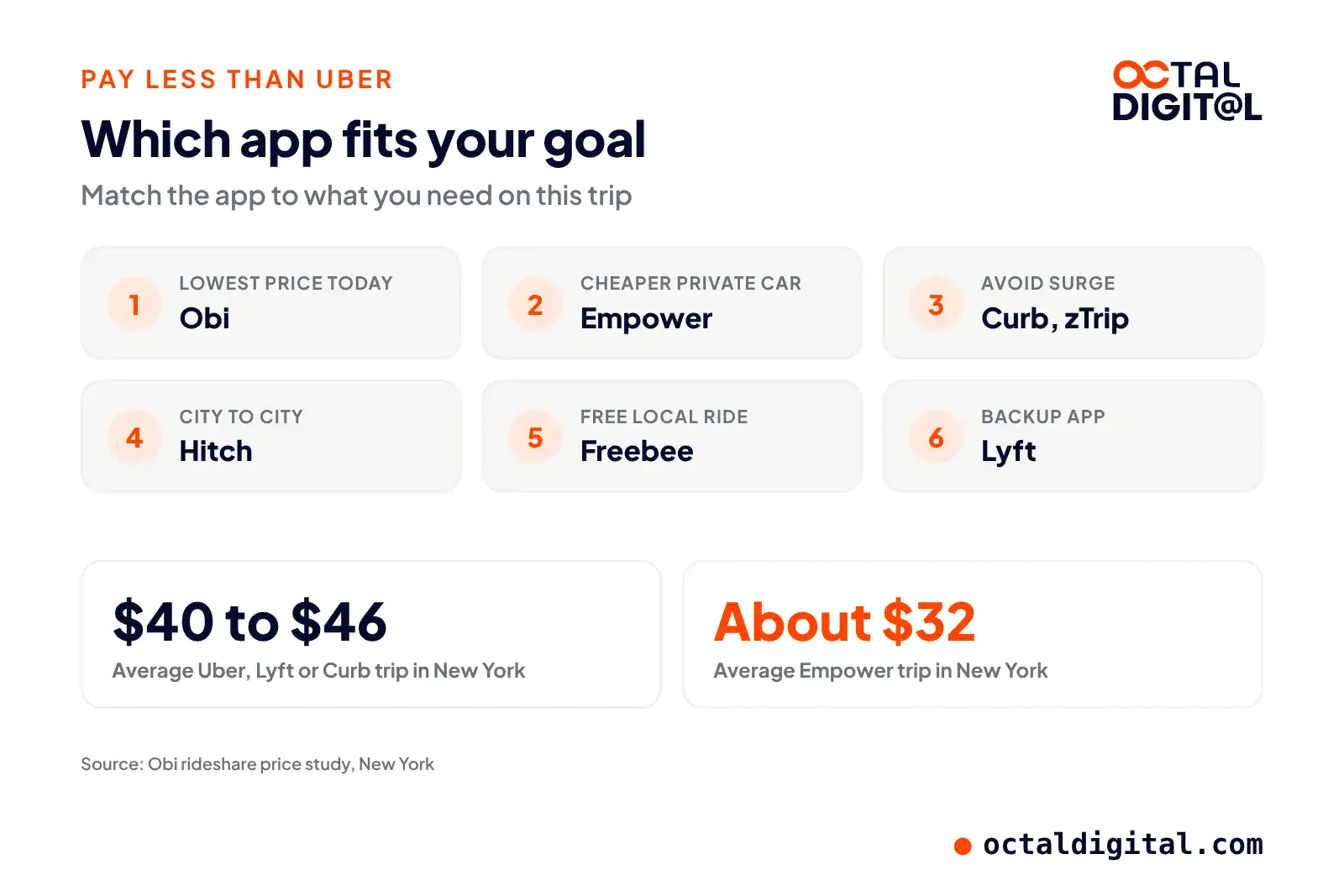
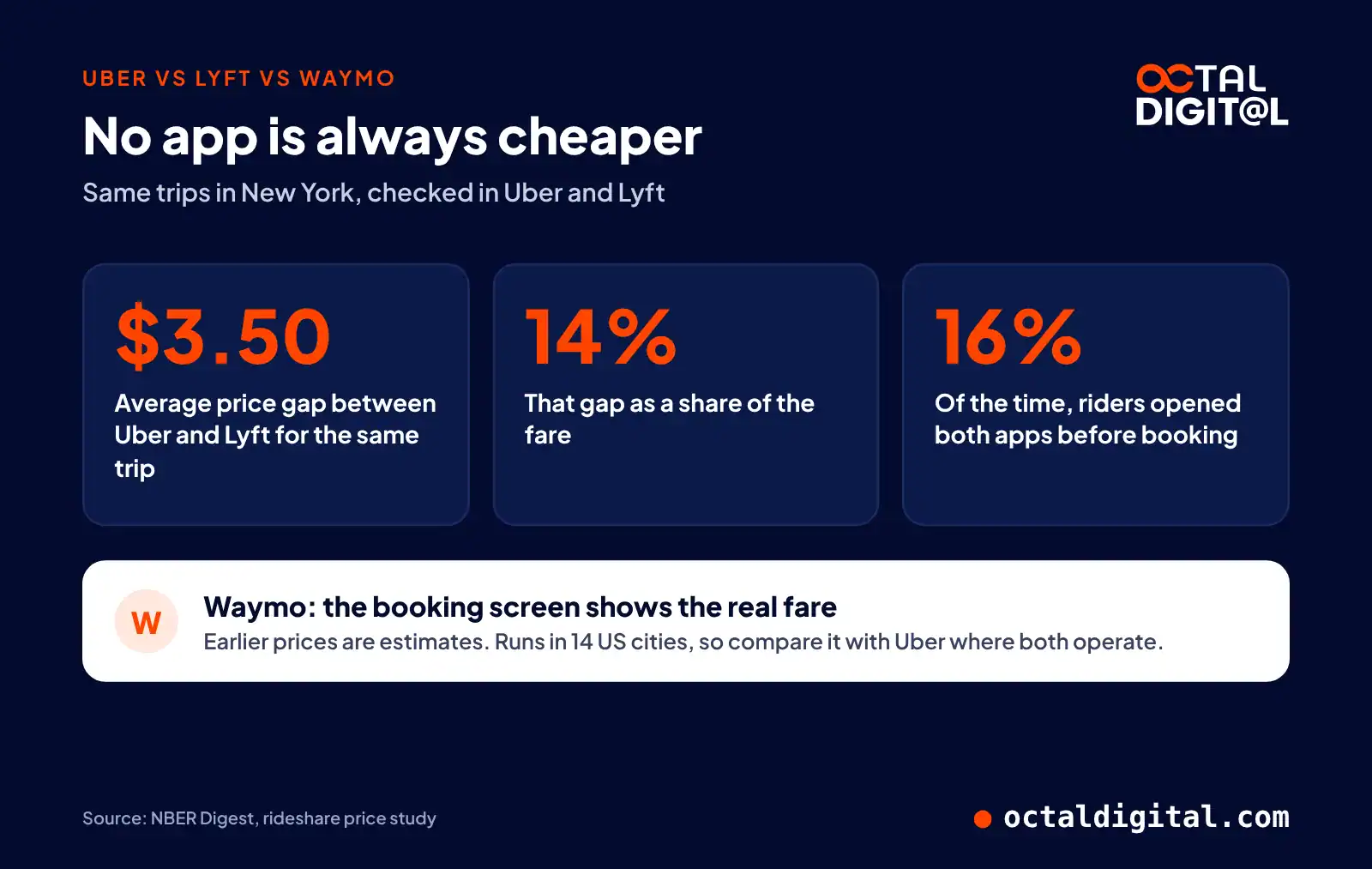
In New York, the average Uber, Lyft or Curb trip came to $40 to $46 in an Obi study this May, while Empower trips averaged about $32. Uber and Lyft fares also change from one trip to the next, reflecting a national pattern of rideshare trips suddenly costing a lot more money when fewer drivers are available. The National Bureau of Economic Research reported this February that in New York, the price gap between Uber and Lyft for the same trip was about $3.50, or roughly 14% of the fare.
There are less-known Uber and Lyft options that are sometimes cheaper than Uber or Lyft because they don’t use surge prices. These ride-hailing apps come as apps, but the apps book actual taxicabs, whose drivers hold real taxicab permits and experience. They charge set city taxi rates instead of quickie “app” surge prices, and follow city taxi rules instead of leaning on GPS.
Curb used to be the taxi tech arm of Verifone, but this renamed company runs an app and, most of all, books taxis at metered or upfront fares, not app surge prices.
You can download Curb for iOS or Curb for Android.
| Your goal | App |
|---|---|
| Lowest price today | Obi |
| Cheaper private car | Empower |
| Avoid surge | Curb, zTrip |
| City to city | Hitch |
| Free local ride | Freebee |
| Backup app | Lyft |
Is Lyft or Waymo Cheaper Than Uber?
Given the number of ever-changing factors at play, such as which drivers happen to be online, what city or town you’re located in (fares in Phoenix or Atlanta may not match those in LA or New York), which part of that city or town you need to depart from and reach, and what hour you plan to travel, it’d be very hard, if not impossible, to firmly say which of these apps offers the cheapest ride.
As a result, this section focuses on the prices in the apps themselves: how those change, what gaps they show, how often those gaps are checked, and how much money they could save you on your next ride.
To test the prices, the researchers checked them on both Uber and Lyft in New York, although there was no single cheaper app; the gaps ran the same way in each direction. (There were real gaps on most of these trips as well.) They found gaps of more than $1 about 75% of the time, yet riders opened both apps only 16% of the time.
It’s worth noting that in Waymo cities, the booking screen is where you see exactly how much you’ll pay, and any fare you may have seen earlier was only an estimate.
Uber Alternatives Outside the US
You needn’t be a frequent flyer to know Uber; it’s become a worldwide name (people even say “grab an Uber” for any ride). But that doesn’t mean Uber is your best option when you land abroad; in fact, in lots of places a local app is the bigger player. The reasons for this vary from country to country, and have been helped by apps built for local payment habits, but most big markets usually have a few strong local rivals.
Some of these apps are very good, with matching ride quality and service levels. This is because lots of drivers sign up for more than one app, keep several apps running on their phones and just accept the first request that pops up (many drivers run Uber and a local app side by side). Other Uber alternatives are only local, as you’ll see below.
Keep in mind that not every one of these options offers peer-to-peer rides; many apps work straight with licensed cab drivers to let customers book a ride, see availability, enter a destination, and pay or tip “regular” cabbies right in the app, much like Uber does. Prices for these rides tend to sit close to the normal local cab rates, meaning you can’t save much money in places where Uber has lower prices, but they do the job.
| Region | Apps to try |
|---|---|
| Europe and Africa | Bolt, FREENOW |
| Southeast Asia | Grab |
| China and Latin America | DiDi |
| India | Ola |
| Spain and Latin America | Cabify |
| Middle East | Careem |
| Canada | Lyft, Bolt (Toronto) |
Apps Like Uber for Drivers
Uber and Lyft may control most of the ride-hailing market, yet if you drive for a living, you likely know you need to spread out which apps you drive and deliver with, so finding good Uber and Lyft alternatives pays off.
While most of the companies we’ve covered are smaller than the better-known competition, you might find you can keep more cash behind the wheel working for a smaller company like Empower or Wridz than you would with the big players.
Want to Build an App Like Uber?
The ease of ridesharing services, the power to call up a ride whenever you want it from anywhere you are, rather than waiting with others at a taxi stand or hoping a driver will come to your far-off neighborhood, has let them take a large bite out of old-style drive-for-hire businesses such as taxis and limos. In ride-crazy New York, for example, the small app Empower now draws enough riders for a price study to track it.
As a result, older taxi companies have started to fight back by turning to custom taxi apps that aim to offer the same sort of services Uber, Lyft and Waymo do. These apps don’t need a giant fleet; rather, they offer a rider app, a driver app and an admin panel for existing taxi companies.
Our US-based team builds these apps: the rider app and the driver app. (As a taxi app development company, we start an app like Uber at $15,000 and set the final price and timeline by scope after a free consultation, at hourly rates of $25 to $50.) Both are big projects, and while each has its own features, platforms and launch cities, most start as an MVP with the booking, maps and payments that the new ridesharing companies made standard.
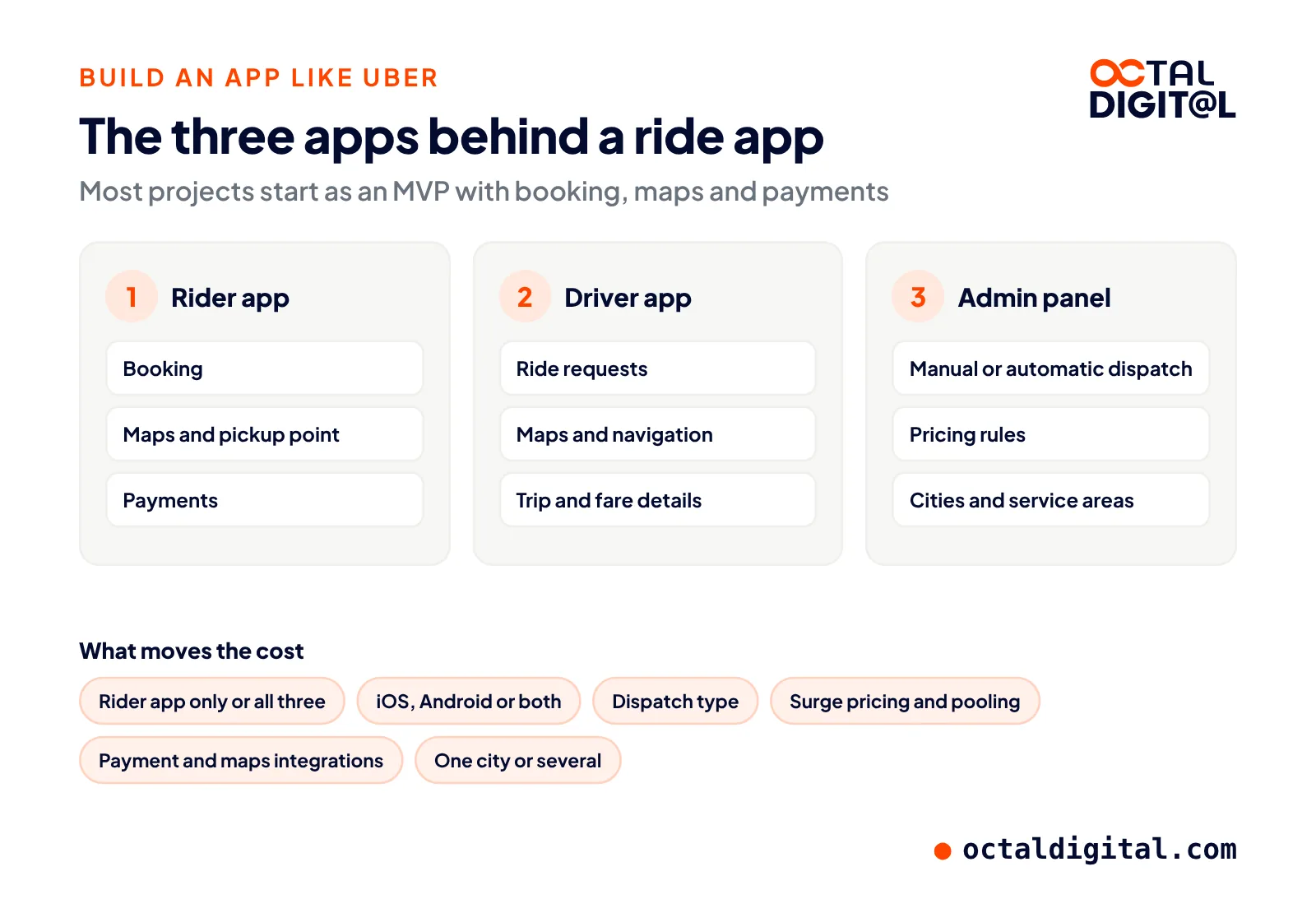
| What moves the cost | Your options |
|---|---|
| Apps | Rider app only, or rider, driver and admin apps |
| Platforms | iOS, Android or both |
| Dispatch | Manual or automatic |
| Ride features | Surge pricing and pooling |
| Integrations | Payments and maps |
| Launch area | One city or several |
Launch booking, maps and payments first, test it in one city, then add features riders ask for.
- A written scope and cost range
- Fixed price or hourly, your choice
- 5.0 rating from 250+ client reviews
FAQs
Is there an app similar to Uber?
Yes. It’s clear Uber isn’t the only rideshare game in town anymore. Whether you’re looking for a cheaper option or one with a different kind of ride, there are plenty of apps vying for your business, with Lyft the closest match.
What is cheaper than Uber?
In the United States, Empower, Wridz, Hitch and Freebee are all worth a look. And if you’re not sure which is cheapest, don’t worry, a price app like Obi will compare many for you on the same trip.
Which ride app should I download besides Uber?
In most cities, whatever you need, there’s bound to be a ride app that fits you. So go on and keep two of them on your phone, you may be surprised at how often the second one is cheaper.
Is Lyft cheaper than Uber?
Not always. Lyft is a service that costs about the same as Uber in New York, where a 2025 price check found neither app cheaper every time. Prices do change by trip, but the gap between the two apps averaged about $3.50, or 14% of the fare.
Is Waymo cheaper than Uber?
Sometimes. Waymo is a self-driving ride app that operates in 14 US cities. It’s also one of the few ride services with nobody in the driver’s seat. Having opened to the public in Phoenix first, you can now use Waymo in cities such as Los Angeles, San Francisco, Miami and Orlando. Waymo can be cheaper or pricier than Uber depending on the trip, so compare both apps, or use Obi, before you book.
Who is Uber’s biggest competitor?
Lyft is Uber’s biggest competitor in the US and one of the largest ride-sharing companies in North America. Though it was founded in San Francisco, it now runs in more than 650 cities across the US and Canada.
Why is Empower so cheap?
If you live in a city where it runs, Empower is one of the cheapest options for ridesharing because drivers set their own rates. Empower says riders pay drivers about 20% less on average than they pay Uber or Lyft, though New York City is suing to ban the app.
How much does it cost to build an app like Uber?
An app like Uber is a complex build that needs a rider app, a driver app and an admin panel. That puts it among the larger app projects we quote, from $15,000, with the price set by scope in a free consultation.
Have a project in mind? Get a free consultation.
Tell us what you want to build. We reply with next steps, a rough timeline and a cost range.
(800) 995-3369
Matthew Jones supports Octal Digital as a Digital Strategist and trusted technology advisor, helping guide clients through scalable solutions, emerging tools, and smart development strategies that align with business goals and growth.