Key Takeaways
1 min summary- Calculating your per-feature cost is key to determining how much budget you should plan for a custom build, which often runs $10,000 to $250,000 or more.
- Many costs are variable, so revisit your quotes often to determine the right amounts, and for reference, Clutch's average reviewed project is $132,480.
- Don't use someone else's budget; each business will have different users and features.
- Having a rough idea of what each feature costs helps you make smarter choices about what you build first and ultimately helps you spend less, with Octal Digital web apps from $10,000.
- Remember that your price will change if you add a user role, if your data needs a big move, if you need a compliance review, if a new tool must connect, etc.
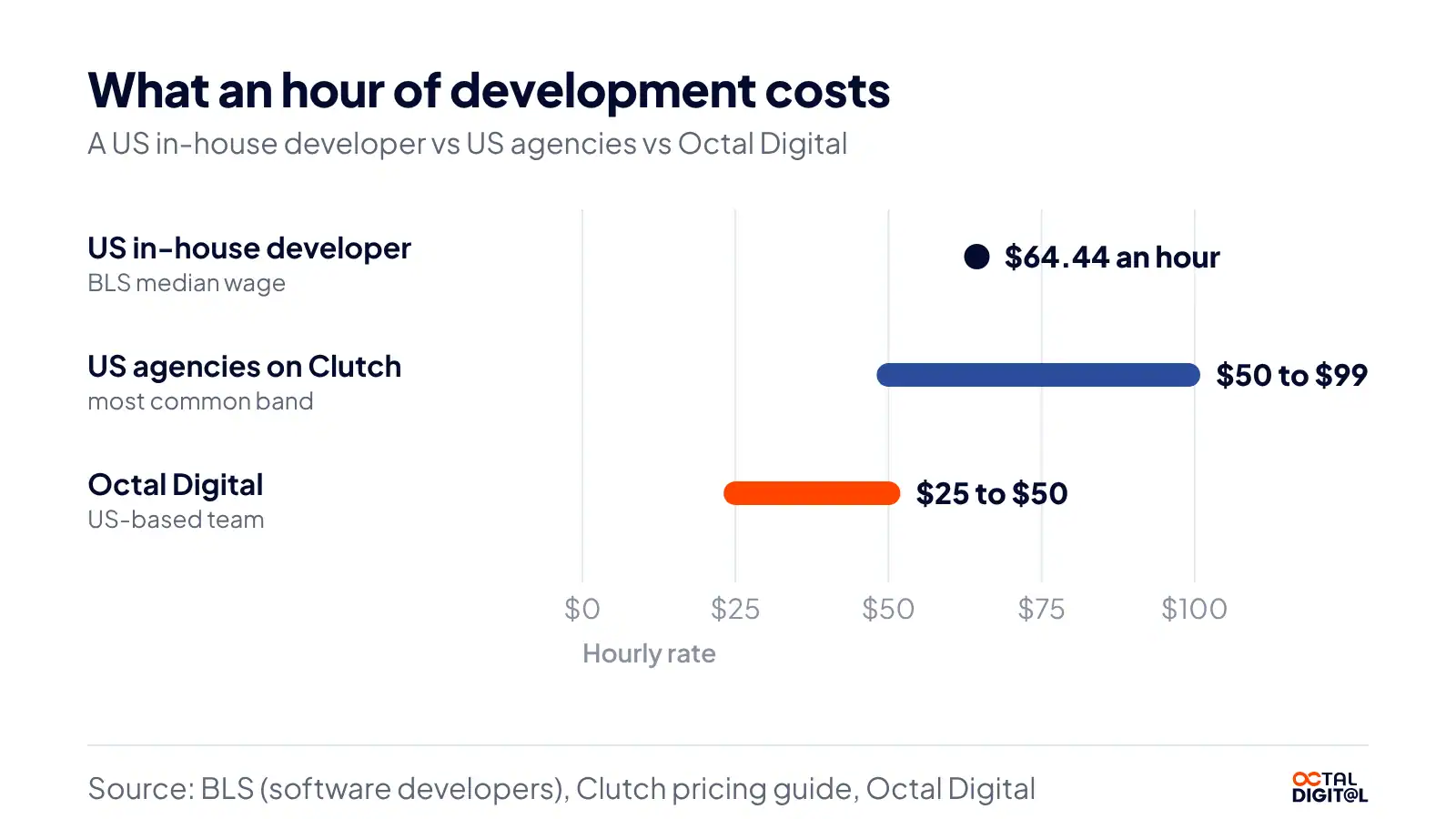
- What's worth noting about hourly rates is that they differ by region: US firms on Clutch charge $50 to $99 an hour, India and Mexico $25 to $49, and Octal Digital, a US-based team, charges $25 to $50.
- For example, if you get a quote that skips hosting and upkeep, budget for them separately, because most build quotes leave them out and maintenance alone runs 15% to 20% of the build each year, plus hosting.
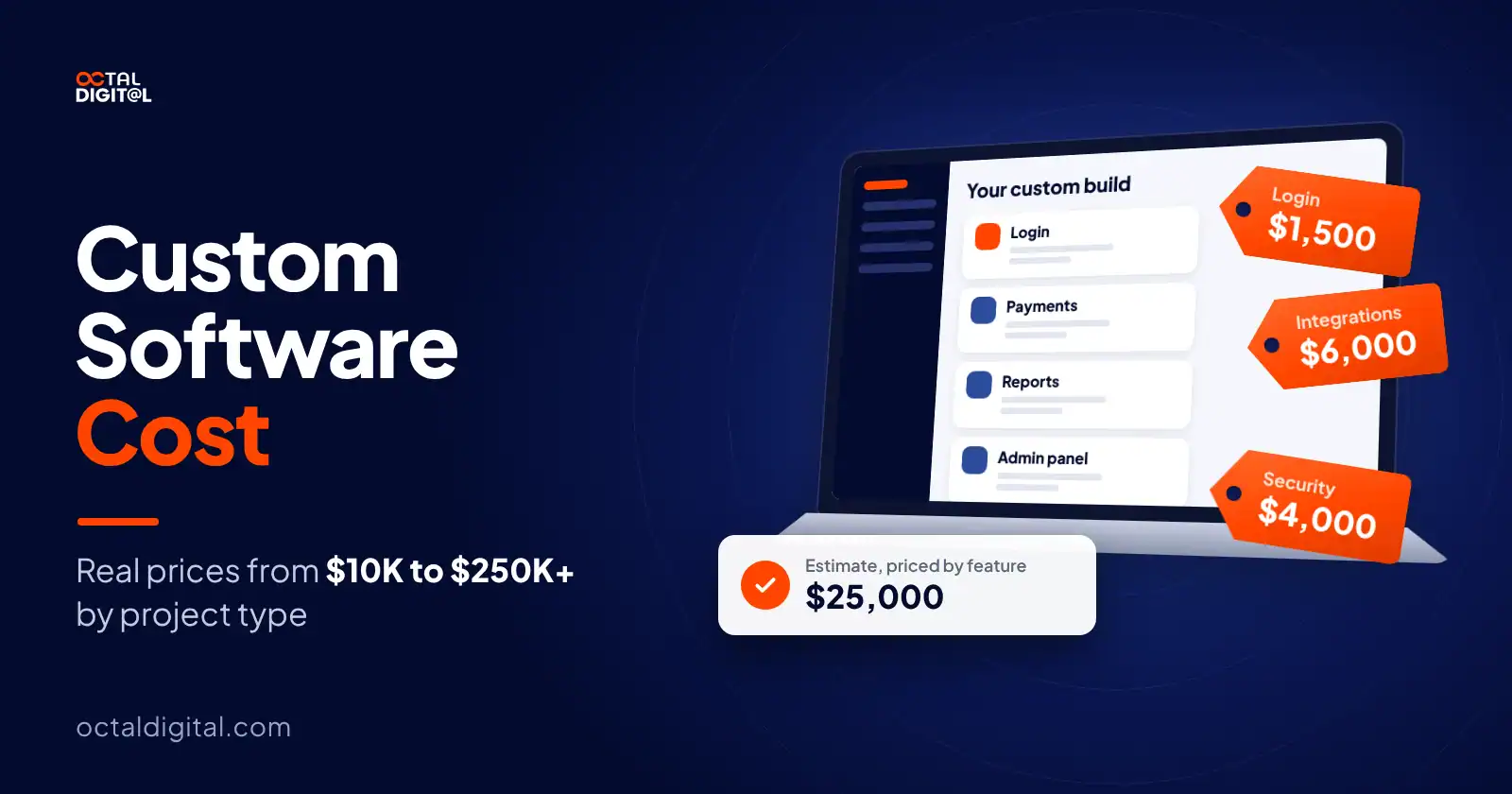
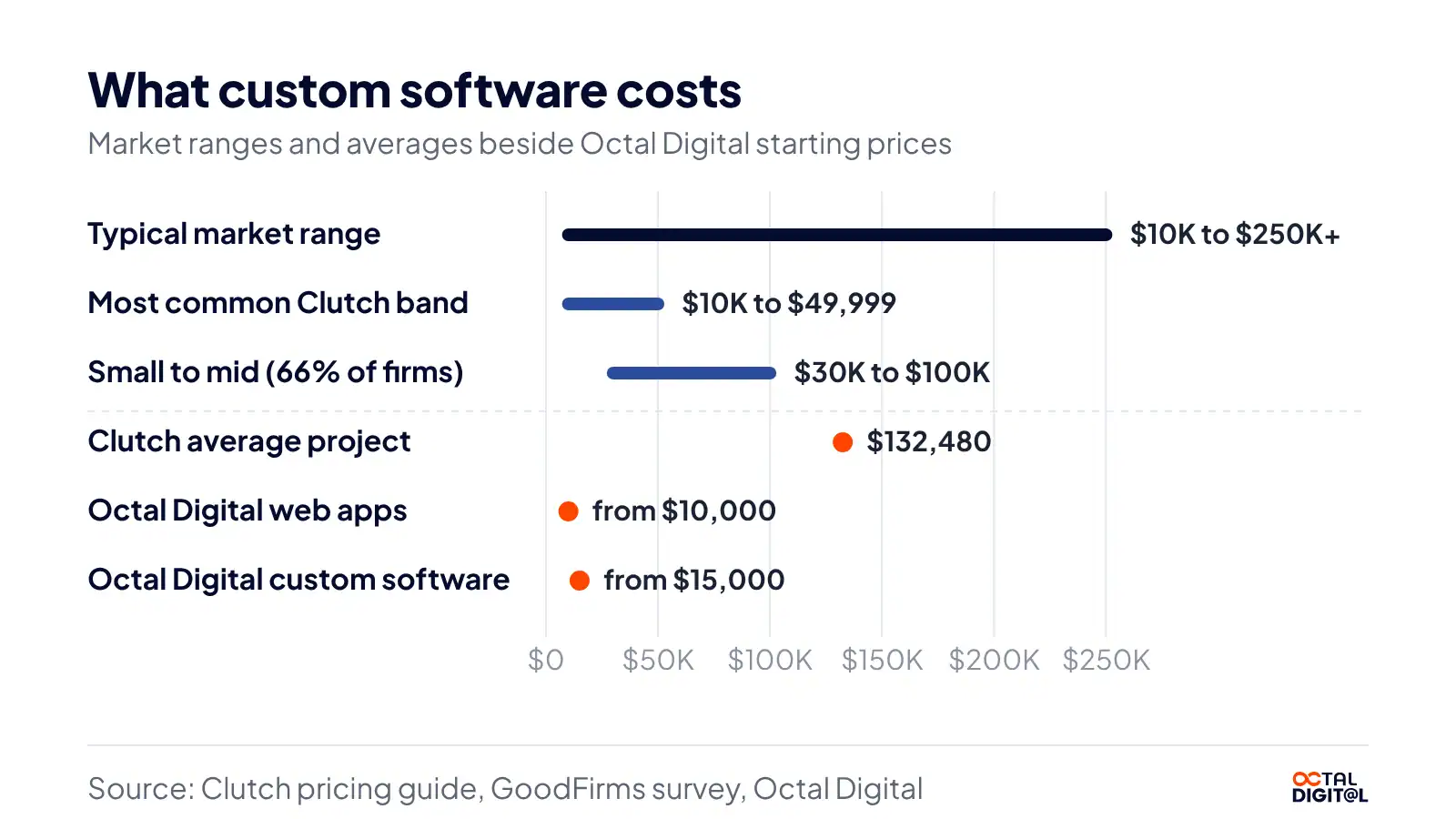
Custom software development costs $10,000 to $250,000 or more in 2026. GoodFirms found 66% of firms charge $30,000 to $100,000, and Clutch puts the average reviewed project at $132,480. At Octal Digital, web apps start at $10,000 and custom software at $15,000. Scope, integrations and team rates set the price.
A lot of owners think custom software is all about writing code. Of course, writing code is the aim, but what many owners don’t realize are the costs involved in planning software for their companies as well. For starters, you’ve got design and testing on your build, extra security so you don’t lose any data, and more. Octal Digital, a software and app development company with offices in Houston, Dallas and Los Angeles, has listed the main costs involved in building custom software. Keep in mind that every project’s costs will vary.
“We got quoted $8,000 this week.”
“We had a $200,000 bid today.”
“We pay our vendor to fix its own bugs.”
No doubt you’ve heard most of these and many versions of each. The truth is, quotes don’t show you the full picture, and they won’t help you decide if custom software is for you, or whether your quote is right.
Looking at real numbers will help you work out if it’s worth it for your business to build custom. Or, if you’re already building, where you can make cuts to keep more of the budget.
How Much Does Custom Software Development Cost?
Custom software usually costs $10,000 to $250,000 or more, and Clutch gives you a per-project average, currently at $132,480 per reviewed software project, and GoodFirms found 66% of firms charge $30,000 to $100,000 for small to mid projects. Calculating your cost per feature is the surest way to judge if a quote is fair because it tells you what each part of the quote buys.
For example, if each feature costs $5,000, you know not to approve any features or extras that save you less than that over the time you run the software.
Two integration-heavy builds we delivered, StaffFlow Pro and iTimeFlow AI, each took 7 months:
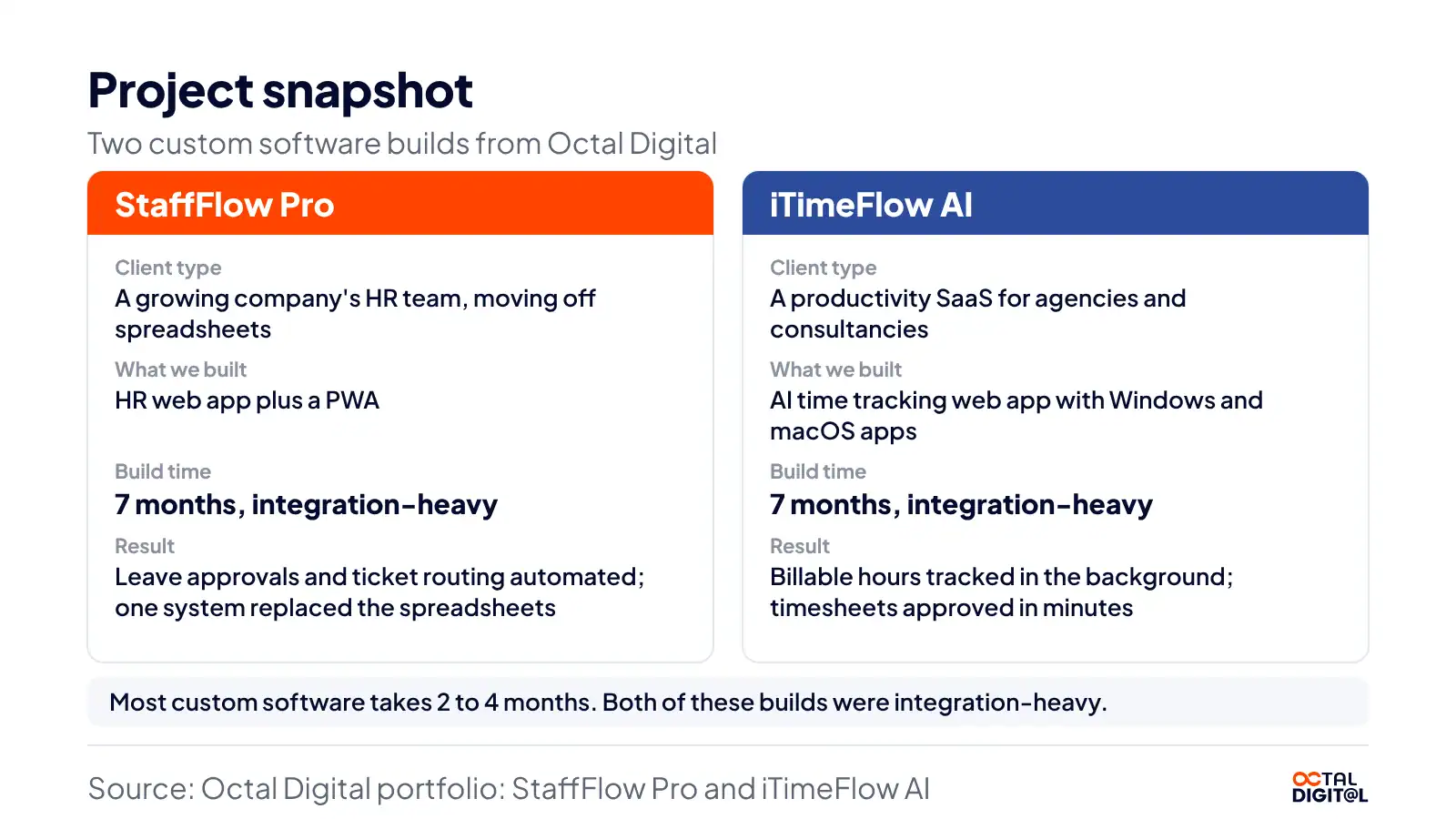
On StaffFlow Pro, we built one HR system that replaced the client’s spreadsheets, and leave approvals and ticket routing now run on their own.
How Much Does Custom Software Cost by Type of Project?
Below are 6 key types of custom software and what each one costs when you plan and price a build for your business, from about $10,000 for an internal tool to $1M+ for an enterprise system. Remember, the type sets your budget, so pick it carefully: portals and workflow apps run $15,000 to $100,000.
Market ranges come from 2026 pricing guides, and Clutch’s most common band is $10,000 to $49,999.
| Project type | Typical market range | Octal Digital starts at |
|---|---|---|
| Internal tool or simple web app | $10,000 to $40,000 | $10,000 (web app) |
| Workflow automation or custom CRM | $15,000 to $80,000 | $15,000 (custom software) |
| Customer portal | $15,000 to $100,000 | $15,000 (custom software) |
| SaaS product | $40,000 to $250,000 | Priced by scope |
| Enterprise system (ERP, multi-team) | $200,000 to $1M+ | Priced by scope |
| AI-powered build (small to mid) | $50,000 to $125,000 | Priced by scope |
When starting out, building on the tools you have now is highly recommended, as investing in a large system without an expected user forecast could leave you in a budget hole over time. However, if you’ve been running a manual process for a while, you will have a clear idea of what the software must do and can brief a custom software development company in Houston.
Between reducing costs with an MVP and picking web app development over a native build, you could likely save yourself thousands on rework during the years you run the software.
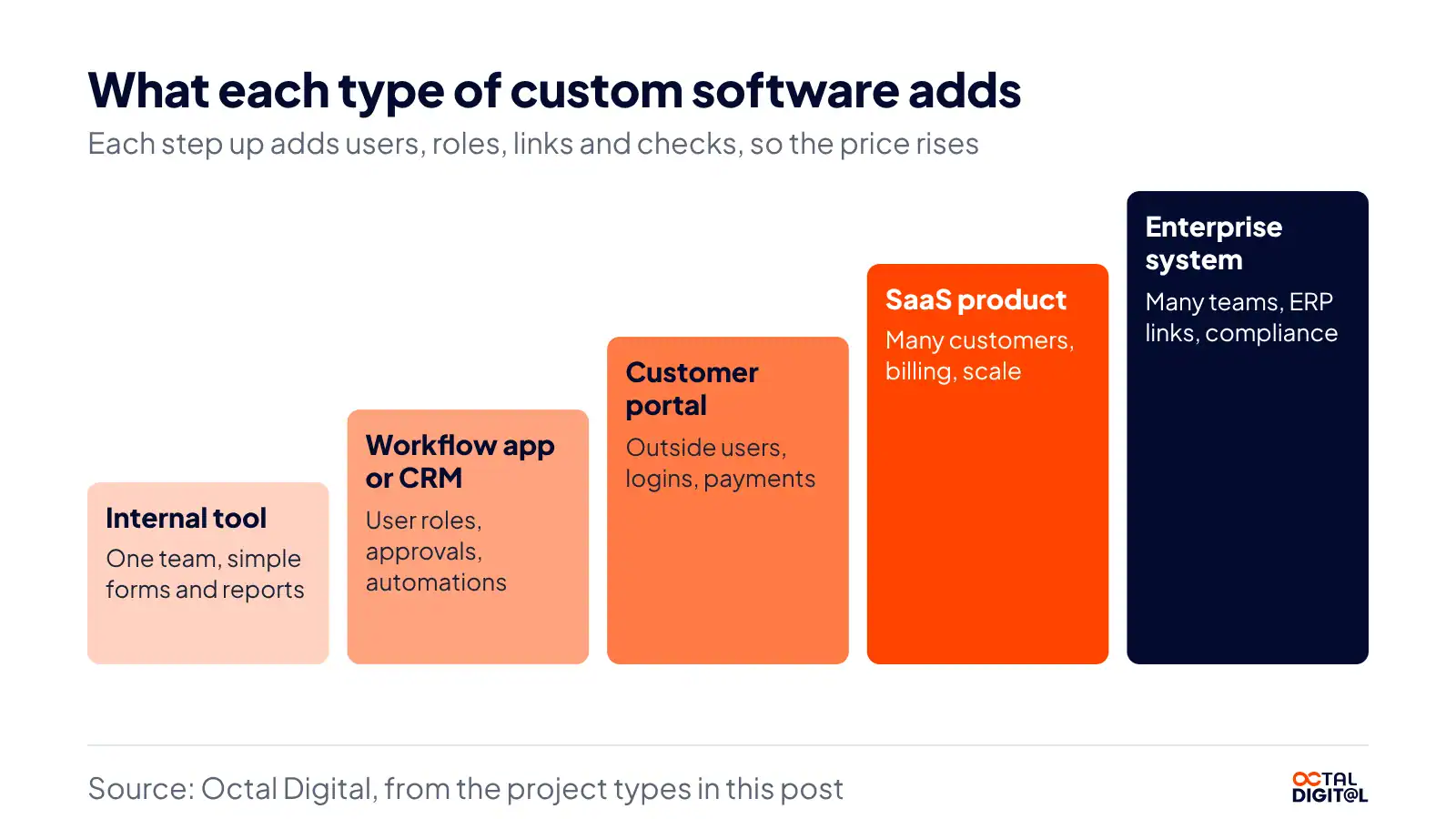
For example, a business can grow into a full portal in later paid phases after starting out with only a $10,000 web app. Our app development cost guide covers the mobile side.
After months of slowly adding features to an MVP, the business works out what the real demand will be from its users.
Tell us your users, features and integrations. After a free consultation, you get a written scope and cost range.
- A written scope and cost range
- Fixed price or hourly, your choice
- 5.0 rating from 250+ client reviews
What Drives the Price of Custom Software?
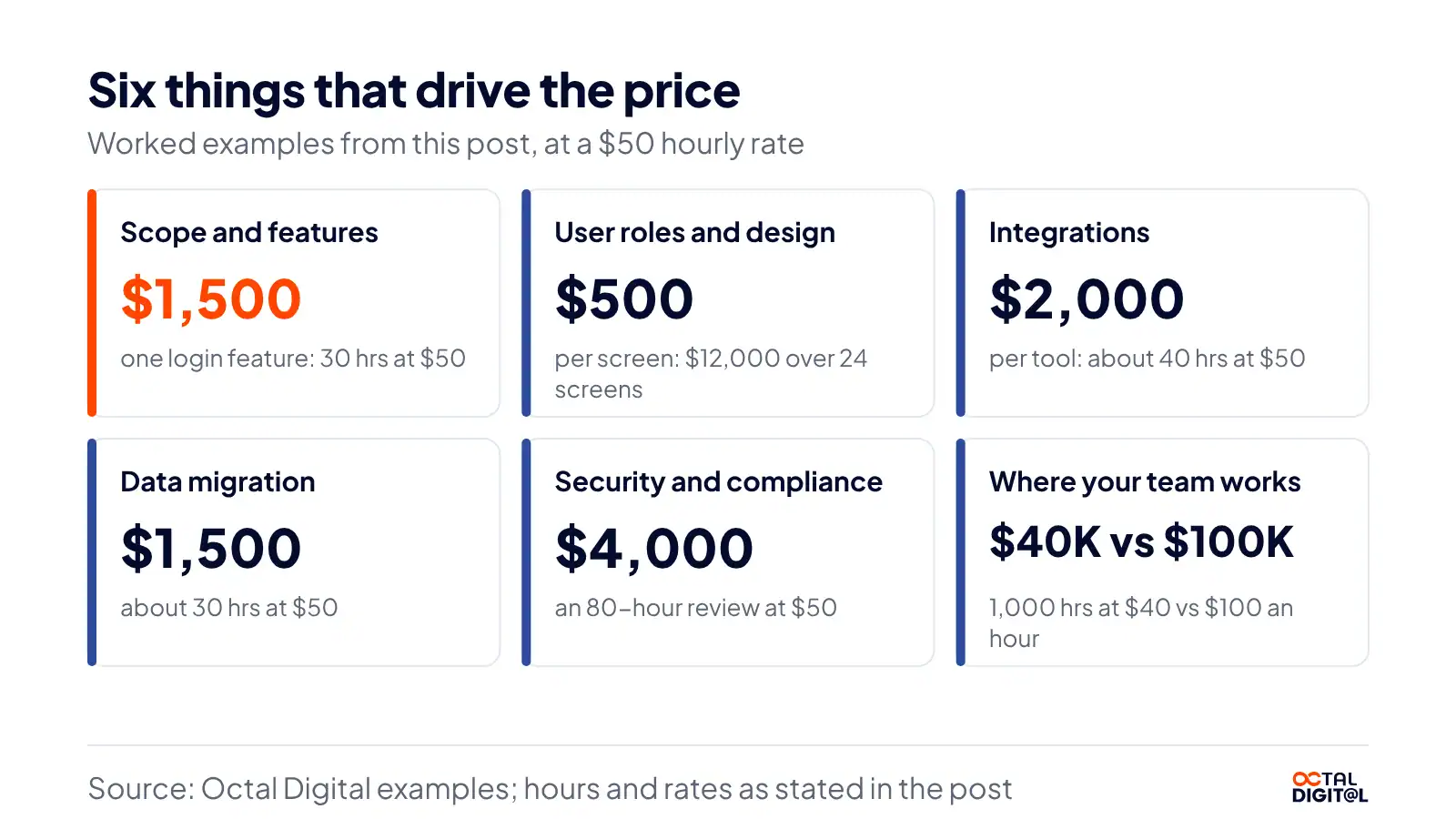
Six things drive the price of custom software: scope and features, user roles and design, integrations, data migration, security and compliance, and where your team works. Scope matters most, because every feature adds design, code and testing hours to the bill.
Scope and Features
The number one expense for many owners is going to be code. Even if you buy a template, you still have to cover that code with money and time. So how do you figure what you’re spending per feature?
As long as you track your hours per feature, you can figure out what you’re paying per feature in code. For instance, a login takes between 20 and 30 hours (users love a simple login); let’s say it’s 30.
US agency rates run higher, but at places like Octal Digital, you’re able to get code for $25 to $50 per hour currently. But we don’t expect every quote to match, so we’ll use the top of that range, $50.
This makes the coding cost per feature $1,500.
30 x 50 = 1,500
User Roles and Design
Design is another large expense you take on to build. To calculate the per-screen cost, take your design budget and divide it by the total screens you need. This can be hard to guess if you’re just getting started, but a good rule for us is one set of screens per user role.
So, if you plan on building for 3 roles, you’re going to design 3 sets. If each set has eight screens, in total, you’ll design 24 screens. Take your design budget and split it by that.
Using this estimation, the per-screen cost for design is roughly $500 on a $12,000 budget. However, this is a cost where the more you reuse the lower the expense gets, alternatively the more custom screens you need the higher the expense.
For example, if you reuse one design system across 3 roles, then your design budget drops, and with it the per-screen cost (based on shared buttons and forms).
Integrations
For this example, say about 40 hours per integration is what it costs for a team to build and test the connection.
A few things to note, these hours only cover the connection itself, and we didn’t count anything for vendor fees like Stripe’s, meaning totals will be even higher.
Also, costs grow the more tools you connect, so if you want to add more tools, or even do a full data sync, your total cost will climb.
A team can usually connect one tool for about $2,000 at $50 an hour. Three tools mean about $6,000, and a full sync of five tools comes to about $10,000.
Data Migration
Your old tools already keep records but sadly, it takes a while to move older data due to poorly designed exports. A team will reformat the daily records from your spreadsheets and old apps into clean tables, making it easier to find any record whenever someone needs to recall it, so the new software works from day one.
Obviously, you’ll never be able to perfectly match every field from the old system, but with careful mapping of old fields to new ones and a few test imports, you might move most data in about 30 hours, or $1,500 at $50 an hour.
Security and Compliance
No matter how well your team codes, you will need a security review eventually. If you have compliance requirements for card or health data, that means you’ll need it sooner than most businesses.
Most apps can guard against the OWASP Top 10 risks if properly planned, and many teams plan on keeping security work in every sprint.
You’re also not smart to wait till you need a review to start paying for it, so factor that into your budget so you know how much you need to set aside to cover this cost as well.
Again, say your app stores card data and your current plan has no review, so you need one before launch. Assuming an extra round of fixes after the review, that means you’ll need a few more weeks before going live.
If that review adds 80 hours at $50 an hour, your security cost for the build is $4,000.
Where Your Team Works
Finally, with all kinds of software, you have to pay a team.
For most business owners, the number of hours you put on your build (and the rate you pay for each) will largely decide the amount you’ll spend in total.
Billing 1,000 hours at $100 an hour will give you a $100,000 bill on hours alone, while $40 an hour gives you $40,000.
However, a lower rate is the best idea only if the team ships clean work, and we hope yours does.
Many owners set aside at least 10% of the budget for changes, just in case the scope grows, and if any of it is left after launch they consider it a “launch bonus.”
Without knowing your scope, it’s tough to say your total cost, but on a $40,000 build, 10% of that is $4,000.
How Much Does Custom Software Development Cost per Hour by Country?
Most of the US firms that you could hire to build custom software cost $50 to $99/hour on Clutch. You can hire for about $25 an hour in India, the Philippines, Ukraine and Mexico, while Canada and Australia run $100 to $149, and Octal Digital, a US-based team, charges $25 to $50.
If you need to hire a team to build your software, be wise about it. You clearly won’t save as much if you pick in a rush on rate alone, so read up on team habits and pick a team where you’re sure there will be overlap (same time zone, similar past builds, fast replies, etc.) By targeting the right team you can beat the cheapest quote on total cost.
That said, it can be smart to only pay a top US rate if your in-house team is busy, or if you’re starting from nothing and don’t have a tech lead. Whether you need a custom software development company in Los Angeles or custom software development in Dallas, the same rule applies, so if you end up having to compare, ask for the hours behind each quote until you can see a fair price.
| Where the team is | Typical agency rate |
|---|---|
| United States, Poland, Spain | $50 to $99 an hour |
| Canada, Australia | $100 to $149 an hour |
| India, Philippines, Ukraine, Mexico | $25 to $49 an hour |
| US in-house developer (BLS median wage, 2025) | $64.44 an hour |
| Octal Digital (US-based team) | $25 to $50 an hour |
Sources: Clutch software development pricing guide (updated September 21, 2026) and the BLS median wage for US software developers.
Fixed price or hourly, your choice. Custom software starts at $15,000 and web apps at $10,000.
What Does Custom Software Cost After Launch?
After launch, most vendors don’t include hosting and support in the build price, so you pay for servers, security patches, bug fixes and new features too. Market guides put maintenance at 15% to 20% of the build a year, so a $50,000 build needs about $7,500 to $10,000 a year in maintenance, plus hosting, with Octal Digital support at $25 to $50 an hour.
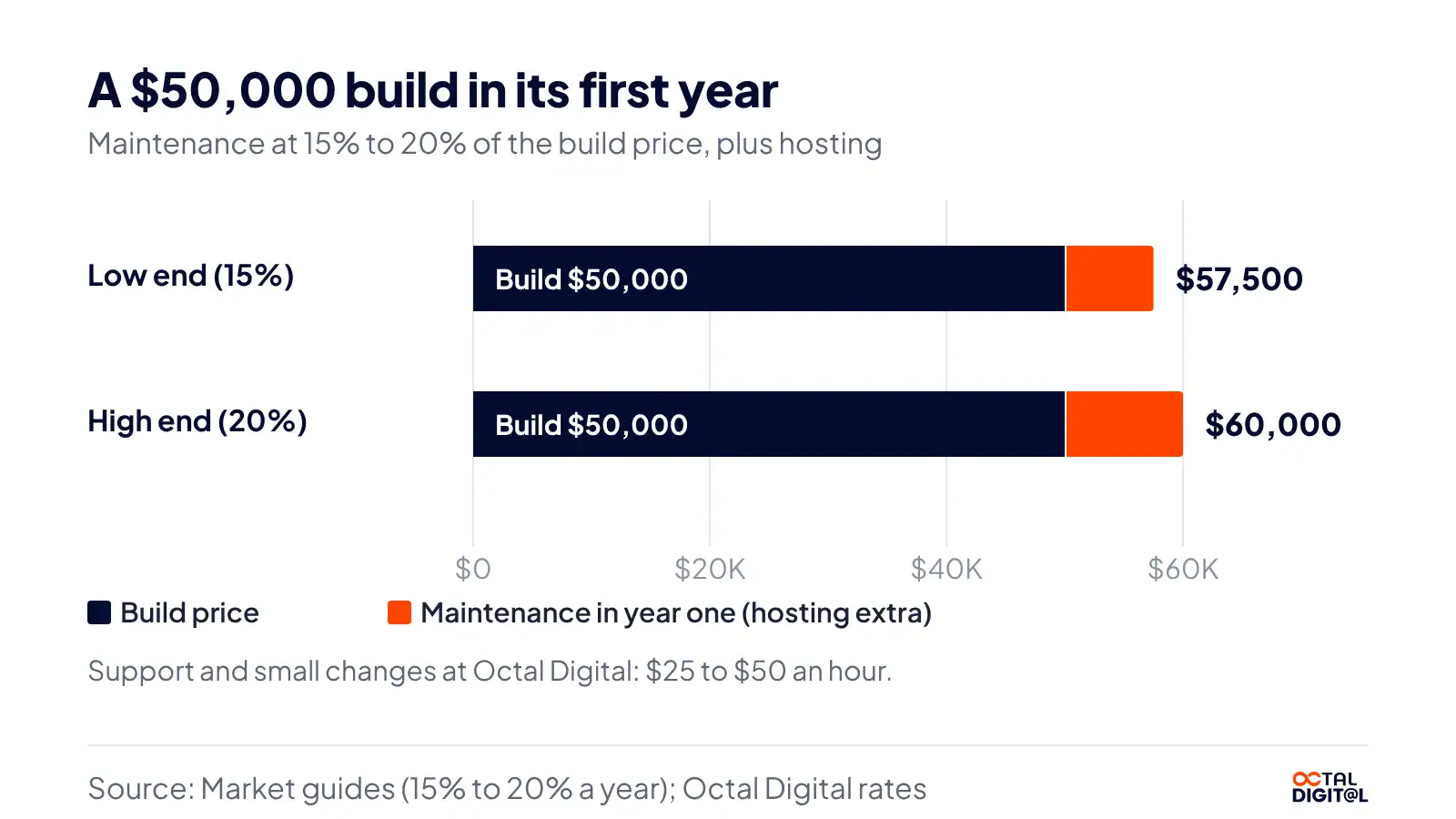
Honestly, this is a bit of a deal breaker for some owners since they’d already be paying $50,000 to build the software. Adding $10,000 in upkeep on top of that brings it to about $60,000 for the first year and that’s fairly close to half a full-time developer’s salary!
AWS asks that everyone pay for what they use each month.
That means they’ll bill you for every idle server you forgot about.
Your servers may be fine but a security patch may be missing. The last team may have patched most of the app and skipped one library by mistake after a long sprint. Make sure to note this so you know who pays for the missing patch under your contract.
As your users grow more and more, you’ll realize there’s a lot of comfort in a plan that covers hosting, fixes, and security. However, without a plan you’ll instead worry about the $25 to $50 an hour support clock ticking in the background with every fix.
| First-year cost | What you pay |
|---|---|
| Hosting and cloud | Usage-based, from your cloud provider’s price page |
| Maintenance and security patches | About 15% to 20% of the original build cost a year |
| Support and small changes | $25 to $50 an hour at Octal Digital |
| Third-party services (payments, maps, email) | Per-use fees, such as Stripe’s card fee |
| New features | $25 to $50 an hour at Octal Digital |
Fixed Price or Hourly: Which Costs Less?
A fixed price gives you a known total and avoids overruns when the scope is clear, because the total is set before work starts. Hourly costs less when the work keeps changing, because you pay only for the hours used. Since large IT projects often run over budget, a written scope protects your money.
Should you buy fixed or pay hourly for your next build? While hourly work isn’t capped, it can be cheaper for small or changing builds. The choice mostly comes down to a few main factors.
These factors include:
- How often you plan on changing the scope
- Long term cost
- Your timeline
You’ll want to decide how much you expect to change the build, how long it takes to build, and what will be cheaper for you overall and give the most value. There are upsides and downsides to fixed and hourly pricing, and Octal Digital starts with a free consultation, then a written scope and cost range. While some owners swear by one model over the other, it’s key to really understand what hourly billing means and why it might or might not be the right call for your current needs.
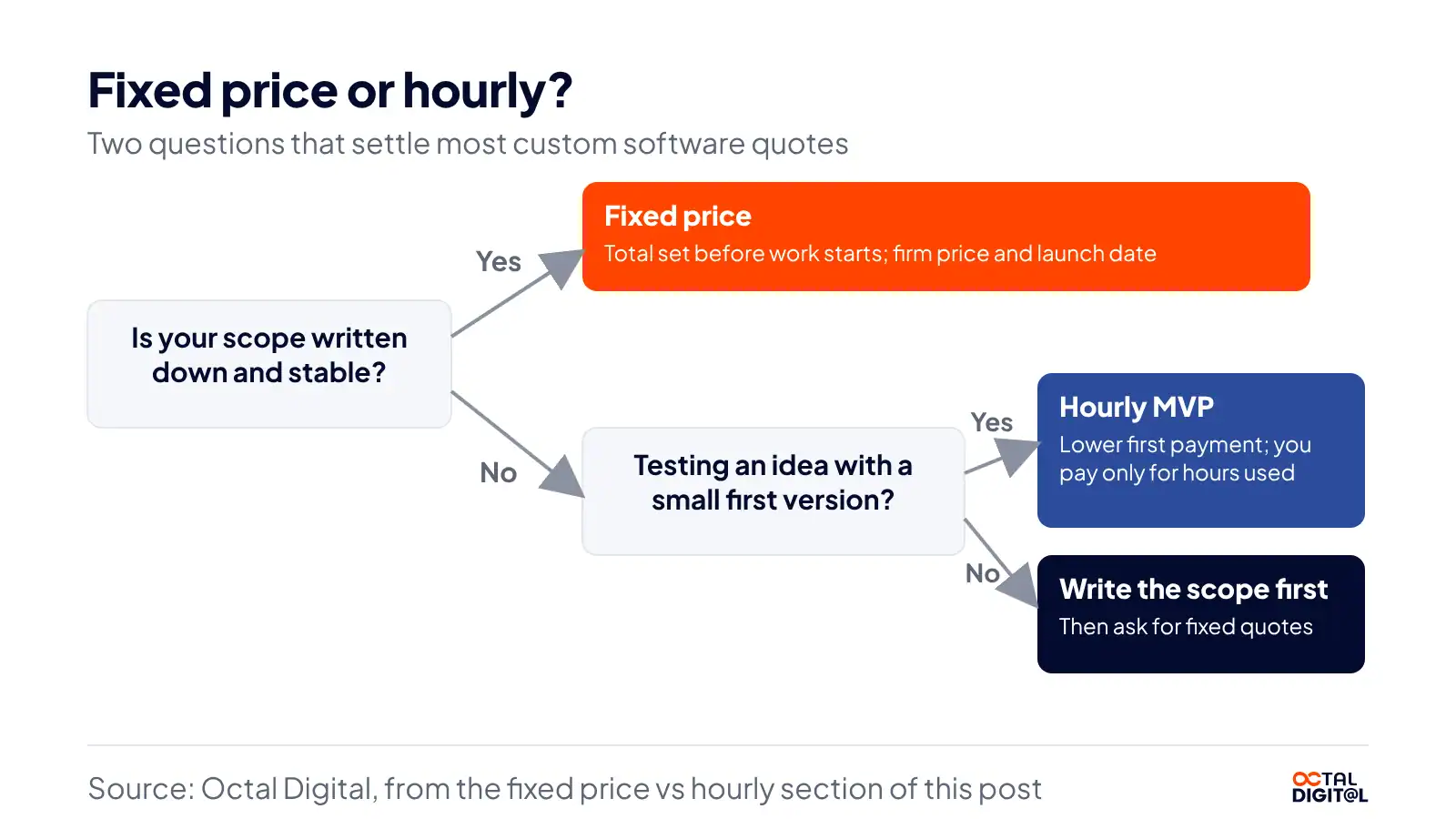
Paying hourly often allows you to start a smaller build for a lower first payment. The average monthly cost on a 6-month build at 160 hours a month and $50 an hour is $8,000.
If you want to test an idea with fewer features and make a smaller first payment, hourly work may save you money upfront compared to agreeing to the full fixed price before launch.
The key benefit of a fixed price is that you’ll know the total before work starts. Yes, the quote may run a little higher, but with a clear spec, you can lock a firm price and even a set launch date. McKinsey’s 2012 study of 5,400+ IT projects shows large ($15M+) projects run 45% over budget and 7% over time on average.
How Much Can AI Lower the Cost of Custom Software?
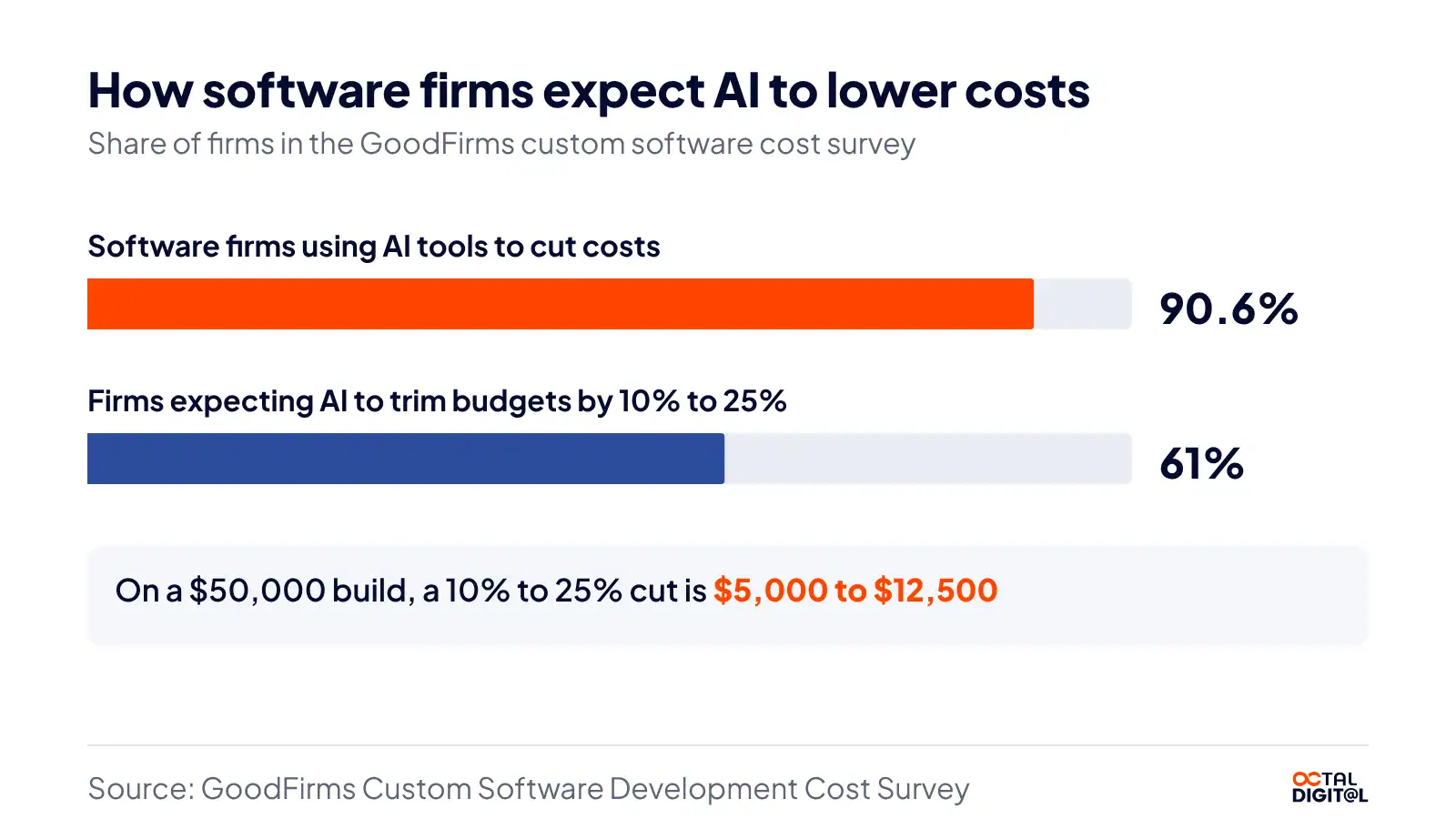
Most firms count AI tools as part of how they save, but is it actually a saving for you? GoodFirms found 90.6% of software firms use AI tools and 61% expect them to cut budgets by 10% to 25%, or $5,000 to $12,500 on a $50,000 build. A small to mid AI-powered build, though, often costs $50,000 to $125,000 in total.
If you don’t do your homework, the AI line in a quote most likely costs you money rather than saving you cash, even with GoodFirms finding most firms now use AI. Often, teams will charge one price if you build the feature by hand, and a second price if you use an AI model. The AI feature shows up as a usage bill, so you’ll be paying the model price for each request. In many apps, the difference between those two can be a few cents a request. So if you pay $0.02 a request more on a feature that users hit 5,000 times a day, that’s about $100 a day extra.
The secret, then, is finding a team where the hours saved in the build beat the extra fees you pay per AI request each month. To work that out, you need to ask each team for its hours with and without AI tools and compare them. The first thing to do is to filter the quotes to show you only teams that list AI time savings in writing, but sadly not every team does.
How Do You Get a Custom Software Quote You Can Compare?
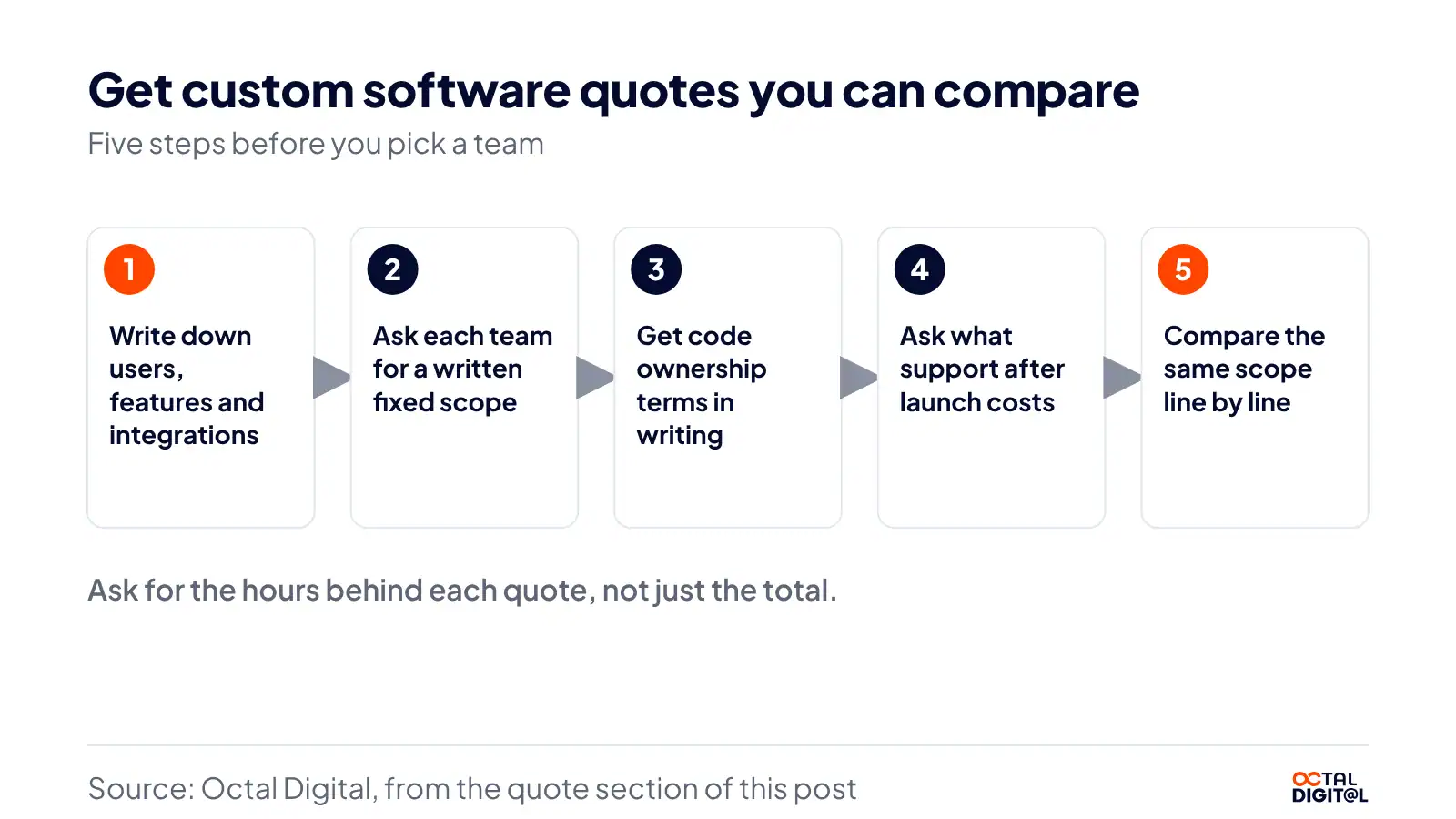
Getting a quote you can compare can seem slower upfront because you’ll write down your users, features and integrations while also asking each team for a written fixed scope, code ownership terms, support after launch and other details. Then compare the same scope line by line, not just the totals.
Determining which quote to pick depends mostly on your end goal. Would you rather pay less money up front and not mind adding features every few months? Then an hourly MVP could suit you, but you must be okay with the limits that come with a smaller first version.
If you’re a business owner looking to get real value for every dollar, a vague quote probably isn’t the best pick since you don’t want to face surprise bills and scope fights.
If you take care of your scope and keep up with a written change log, you will likely spend less on rework over time as your software grows. Plus, you can ask each team for a free consultation and keep the same written scope, code ownership terms, and support plan in every quote.
When it comes to picking a team, you want the best hourly rate, but be careful with very low offers. Many times, when you’re offered a very low rate, you’re paying for a junior team with no testing or support plan. Paying a lower rate may not be a huge win if you need far more hours overall.
Write down your users, features and integrations, but also start with an MVP or reuse your existing tools to reduce the overall build amount. Make sure you can afford the build price and all your other regular software expenses too.
We list the hours, rates, code ownership terms and support after launch, so you can compare us with any team.
- A written scope and cost range
- Fixed price or hourly, your choice
- 5.0 rating from 250+ client reviews
FAQs
What Is the Cost of Software Development?
Software development doesn’t have one set price buyers can look up; however, it has common ranges. Most business projects cost $10,000 to $250,000 or more; of course, a good team shows you the cost of each feature so you can choose whether to build it.
How Much Do Companies Pay for Custom Software?
Clutch’s reviews show companies pay $132,480 on average for a software project, and the most common band is $10,000 to $49,999. Teams typically price it based on the estimated hours and features of the build, the team’s location, and integrations. Ask if they also factor in extra costs, such as hosting and support after launch.
How Much Does Custom Logistics Software Development Cost?
Logistics software often starts as a dispatch or tracking web app, priced like a workflow tool at $15,000 to $80,000. However, if you want live GPS tracking, route planning and driver apps, you can expect a larger scope and a quote priced by feature.
How Much Does a Software Update Cost?
A small software update can be billed by the hour or as a fixed task. If you already have a support plan with your team, small fixes are usually covered and new features are billed at your set rate, which is $25 to $50 an hour at Octal Digital.
Is Custom Software Cheaper Than Off-the-Shelf Software?
Custom software can cost less over several years, as off-the-shelf software costs less upfront but charges per user each month. Custom software owners don’t pay those seat fees, which for many users can outrun the build plus upkeep. Owners are independent of the vendor and responsible for their hosting and all upkeep.
How Long Does It Take to Build Custom Software?
There are some options if you need custom software fast, but most builds take 2 to 4 months. First, see which features are the most important in your first version. For example, if you only need an MVP, it can be ready in 1 to 3 months, and an integration-heavy build takes 4 months or more.
What Is the 40/20/40 Rule in Software Engineering?
In the 40/20/40 rule, teams give 40% of the time to planning and design, 20% to coding and 40% to testing. Most teams don’t follow it exactly, but like any rule of thumb, it has a point. The nice thing about the rule is that testing is part of the plan, so you get a larger say in quality before launch.
Who Owns the Code When You Pay for Custom Software?
There are many terms a team considers when writing your contract. It’s a complicated topic, but the most common terms are who owns the source code, the design files and the IP after final payment. At Octal Digital, all three are yours after final payment, and we sign an NDA before you share project details.
Have a project in mind? Get a free consultation.
Tell us what you want to build. We reply with next steps, a rough timeline and a cost range.
(800) 995-3369
Michael Husky is the Director of Sales & Marketing at Octal Digital, leading growth strategy, client acquisition, and brand positioning across mobile, web, and AI services with a results-driven, consultative approach.