
The user interaction around us is changing rapidly with the rise of Augmented Reality (AR). From transforming online shopping experiences by allowing consumers to virtually try on their choices of clothes to improving education by giving historical events the life they deserve; Augmented Reality apps have huge potential in them. But now the next question that arises is how to create an Augmented Reality app that achieves your purpose?
This blog will show you every bit of this exciting process, from the concept of the app to its practical reality and creation.
How to Create an Augmented Reality App: Types of AR Apps
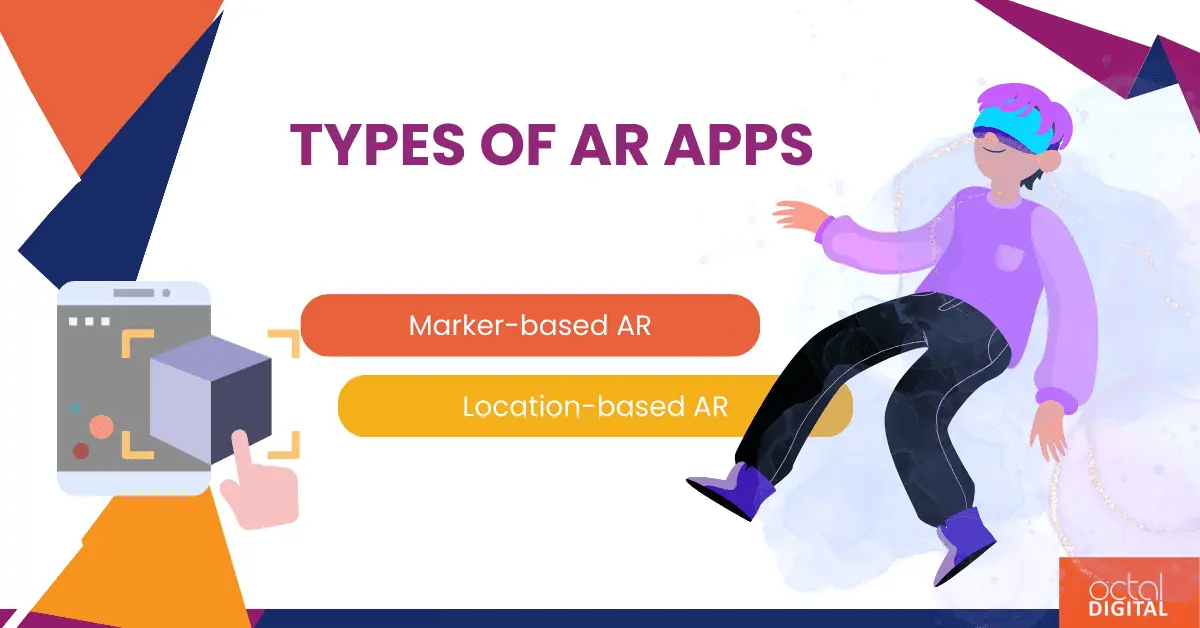
Before moving to the technical aspects of how to create an Augmented Reality app, it’s crucial to take into account the types of AR experiences you want to develop. There are basically two main categories, each category offers its own distinctive features and usage:
- Marker-based Augmented Reality apps: These apps depend on physical indications or markers, like images or objects, that the app can comprehend. Once the device’s camera detects the marker, the app adds layers to the digital content on top of the object or image in the real world. In other words, it overlays the marker. For example, consider pointing your phone at a particular product in any supermarket or store and seeing a 3D animation demonstrating all its features with informative text about the features and specifications alongside its reviews. This particular technology can be helpful for:
- Product visualization: This technology allows the customers to experience virtual try rooms for their clothes, they can visualize the furniture in their homes before buying or could experience how a new appliance would look in their kitchen area through this technology.
- Educational purposes: For educational purposes, it can create engaging elements linked to specific images in textbooks or just simple worksheets. For example, let’s imagine a textbook of science where pictures of planets or cells come to life with 3D graphics and information labels when users view through the AR app.
- Scavenger hunt-style games: In design geographically based games where the users need to locate images or objects that are hidden and out of sight around a specific area to move further in the game. These objects could generate puzzles, show clues, or open new challenges.
Do you want assistance on “How to Create an Augmented Reality App”? We would love to! Our experienced and professional team at Octal Digital will work intently with you to assist you through each step of the augmented reality (AR) app development procedure. From processing your concept to implementing and finalizing the final product, we ensure that your AR app aligns with your vision and go above your expectations. Get in touch with us!
2. Location-based AR: The location-based apps utilize GPS and other location services to provide AR experiences bound to specific places. Let’s imagine that you are exploring a city and seeing historical attractions come to life on your phone’s screen, with educational pop-ups or even interactive reenactments of historical events. Location-based AR can be an impressive tool for:
- Tourism: Enhancing the exploration of new attractions and places with more detailed information, viewing the historical destinations, architectural and technical details, or even the meal menus of restaurants displaying on the phone’s screen as you walk around exploring a new city.
- Educational purposes: Allowing the students to visit historical and ancient landmarks or get the experience of geographical details they otherwise may not be able to see in person through virtual experiences. Like, consider a virtual tour of the pyramids of Giza or the reenactment of a volcano eruption, all experienced through the lens of a powerful and useful AR app.
- Augmented navigation: It can provide step-by-step directions with AR overlaying the content that guides the users to their desired destination hassle-free. For example, just imagine walking directions that display the next turn you should make or meal recommendations of famous restaurants that can appear as arrows pointing in the right direction.
The Building Blocks for “How to Create an Augmented Reality App”
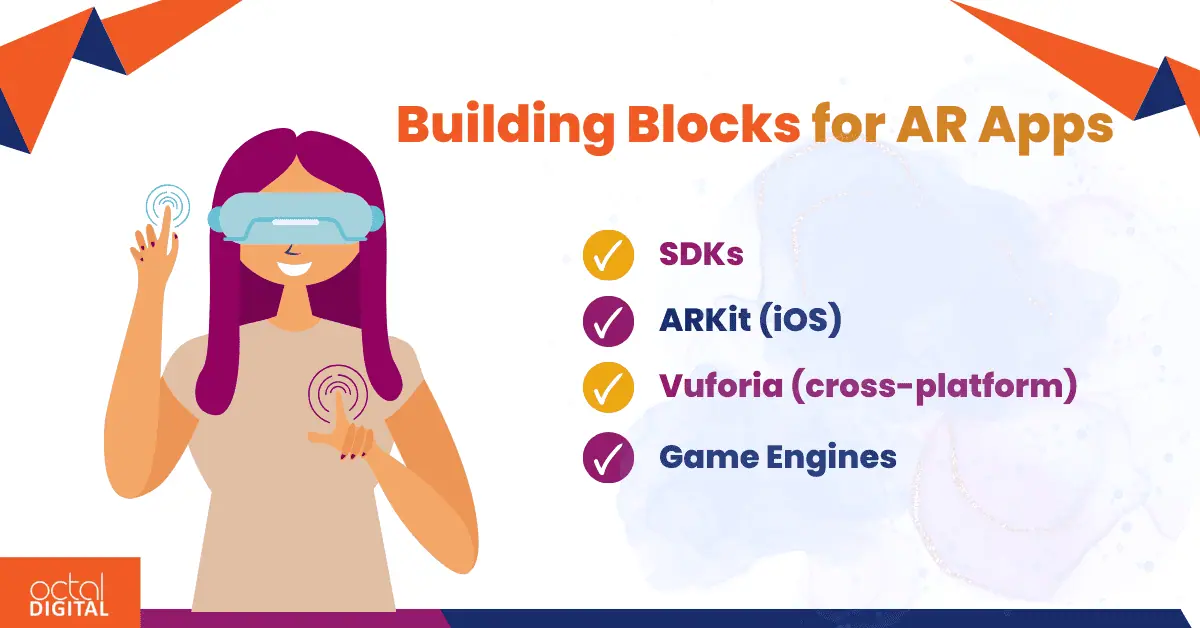
The query of how to create an Augmented Reality app has many answers, because of different tools and resources to match with your particular needs and wants. Here comes a summary of some popular options to get you started:
Software Development Kits (SDKs): These are considered as the comprehensive package particularly designed for AR development. Some common options include:
A. ARCore (Android): ARCore which is developed by Google, is a free SDK that makes the building of AR experiences for Android devices easier. It gives the tools for:
- Motion tracking: The capability to trace the mobility and orientation of the device in actual time, which allows for the precise positioning of AR objects in the user’s surroundings.
- Environmental understanding: The ability to detect and comprehend the physical world around the device, such as the faces, surfaces, angles, planes, and lighting conditions. This allows AR objects to interact accurately with their surroundings.
- Light estimation: The ability to estimate the lighting exposures in real-time, which allows AR objects to be provided with accurate lighting and shadows of the objects for a more practical and real experience.
B. ARKit (iOS): ARKit by Apple is a powerful structure for building Augmented Reality apps for Apple iOS devices. ARCore offers functionalities for:
- Device motion tracking
- Real-time scene understanding
- Light assessment
C. Vuforia (cross-platform): If you’re searching for an AR app that can work on both Android and iOS devices, Vuforia is a popular multi platforms option. It provides a development atmosphere that enables you to develop and make AR experiences once and use them on dual platforms, optimizing the development process. Vuforia offers characteristics like:
- Image recognition: The ability to identify and track images in the real world, which are the markers for the experiences on AR.
- Object recognition: The capability to comprehend and trace the 3D objects in the real-time, which can be used to enforce AR overlays on real objects or interactions with it.
Game Engines: If your AR app consists of complicated 3D elements or simulations, consider using a game engine such as Unity or Unreal Engine. These compelling tools offer a complete environment for building interactive and engaging AR experiences. Game engines usually provide characteristics like:
-
- Physics simulation: It allows reality-based physics link between AR objects and the real-time data and markers. This can be helpful for developing AR games or animations.
- Animation tools: It enables the users to create smooth, functional and interactive animations for your AR markers, brings them to reality and improves the UX (user experience).
- 3D animation: It helps to generate high-quality 3D graphics for your AR markers and makes sure that they look closer to reality and incorporate flawlessly with the real world.
Recommended Read: How Much Does It Cost To Make An App – Best Guide of 2024
Crafting Your Vision: Steps to Create Augmented Reality App
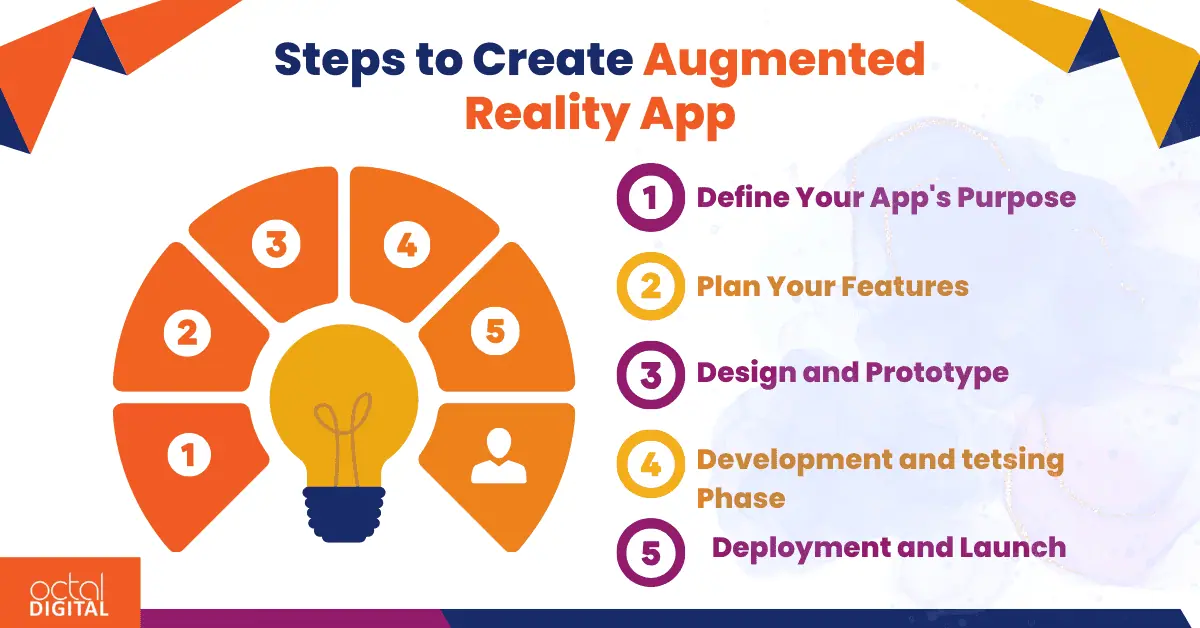
Now that you have a basic understanding of the different types of AR apps and the programming tools available, let’s explore the steps to make your Augmented Reality a reality.
- Define Your App’s Purpose: First, clearly define and understand the problem your app aims to solve or the user experience you want it to deliver. What value are you expecting it to bring to users? Is it developed to educate, entertain, or offers an essential function? Just by having a clear aim will lead your programming decisions and makes sure your app stays on track. Consider the following questions:
- What problem are you aiming to solve or what need are you satisfying with your AR app?
- Who is your intended audience? Understanding who the users are, will help you develop and guide the AR experience to their potential needs and desires.
- What unique value proposition or distinctive selling point will your AR app offer compared to existing apps?
- Plan Your Features: Start by making a list of technical specifications your app will offer to achieve its aim. Think of creative ways to use AR technology to improve the user experience on the app. This could involve characters like:
- 3D object placement: It allow the users to virtually see the objects in the real world and connect with experience and interact with it. This could be absolutely anything. From furniture to historical artifacts to clothes to fantastic creatures, anything.
- Interactive animations: Make graphical animations that comply with user interaction or the surrounding of the user. You can imagine a virtual pet. It can react to your touch and can make sounds. Or it can be a historical figure that can come alive and tells a compelling story when you point your phone at a specific location relevant to it.
- Location-based information overlays: Provide users with more information about their surroundings based on their location than normal already provided information. This could include past facts about land markers, restaurants, their menus, or even step-by-step directions.
- AR games: Developing games that make use of AR technology to construct immersive and interactive virtual experiences. For example, imagine a treasure hunt game that leads the players to hidden places in the real world or it can be a puzzle game that requires users to change and use the virtual objects in their surrounding environment.
- Designing and Prototyping: Before going to code, create models and prototypes to visualize your app’s and user interface and user flow. This will help you refine your ideas, consider any potential usage issues before it gets commercial, and always ensuring that your app is easily navigated and understandable. Various tools are available such as Figma or Adobe XD which can be very useful in creating these mockups. Here are some attributes to consider during the design and development phase:
- User interface (UI) design: Creating a user-friendly interface that is easily navigated and understandable is crucial. The UI aims to be clear and concise, and it should be designed in such a way that it can’t distract from the AR experience.
- User experience (UX) design: Planning the user flow of your AR app and ensuring that it is spontaneous, naturally intuitive and interacting. Users should be able to easily understand how the app is supposed to work and get the work done.
- Development Phase: Here’s the main point where the coding magic happens. Make use of your chosen SDK and coding tools to build the essential functionalities of your app.
A) For Android development: If you’re bound to work on Android, consider getting closer with resources which help in building a easy AR app with Sceneform which is Google’s AR SDK. Sceneform offers a user-friendly application programming interface (API) for building simple AR experiences which includes:
- Placing 3D objects on identified surfaces like tables or floors etc.
- Employing textures and materials to your 3D objects for a reality based look.
- Stimulating your 3D objects to create innovative and collaborative experiences.
B) For iOS development: For iOS or Apple app development, ARKit provides a strong framework for creating AR experiences. Apple provides with the massive documentation and guides to gear you up with building AR apps using ARKit and Swift or Objective-C programming languages. ARKit is the app which offers similar functions to Sceneform, allowing the user to:
- Identify and track real-world objects and surfaces.
- Making and anchoring 3D animations in the real world.
- Apply physics simulation to the AR markers for closer to reality interactions.
- Testing and Refinement: Thoroughly test your app on various devices and platforms to make sure that the performance is smooth and to detect any errors or bugs. Closely pay attention to in which way the AR elements act together with the real world in different lighting conditions, events and on different device models or software. Here are some aspects that you should on during testing:
- Performance: Ensuring that your app runs smoothly without any delay or lag or frame rate drops makes a difference when compared. This is vital for a progressive and optimistic user experience in AR.
- Accuracy: Checking how perfectly your app spots and tracks real-world surfaces and objects without any lag or error. Flaws in the process can lead to a disappointing user experience.
- Usability: Get constant feedback from potential users and initial users to get an idea of any usage issues. Is your app understandable and easy to navigate? Are the AR features clear and interactive?
- Deployment and Launch: Once your app is enhanced and vigorously tested, it’s time to release it and share with the world! Preparing for app submission is essential following the specific guidelines for each destined platform (Android or iOS). This may have:
- Creating app screenshots and videos: Showing the AR features of your app in a visually attractive way.
- Writing engaging app store descriptions: Highlight the unique selling point of your AR app and what you think makes it stand out from the competition.
- Ensuring your app meets the specifications and technicalities of each platform: Both Google Play Store and Apple App Store have specified instructions that your app needs to observe, before it can be published.
Before officially launching any AR app, Octal Digital thoroughly reviews and adheres to the specifications made by app stores platforms like Google Play Store and Apple App Store. Our professional AR app development team ensures that our apps meet all requirements for submission, which includes content guidelines, app store policies compliance, and legal regulations.
Conclusion
Augmented reality is a promising technology to revolutionize the way we network with the world around us. By following the steps mentioned in this blog “How to Create an Augmented Reality App” and staying educated about the latest trends and events, you can be a part of AR. No matter if you are a prospective developer, an entrepreneur with an innovative idea, or an individual who is keen about this emerging technology, there’s a space for you in the world of AR. So, let’s dig deeper, explore the never-ending possibilities, and get ready to be stunned by the potential of augmented reality!
FAQs
How to Create an Augmented Reality App for iOS?
Creating an augmented reality (AR) app for iOS devices which differ from android ones involve utilization of development frameworks like ARKit, Apple’s AR platform. Our team of experts at Octal Digital are well-experienced in iOS app development and can guide you in leveraging the power of ARKit to create interactive AR apps for iPhone and iPad users.
How to Create an Augmented Reality App for Android?
To create an augmented reality (AR) app for Android which again differs from iOS, you can use development and coding tools like Unity or ARCore, Google’s AR development platform. Our expert team at Octal Digital is expert at Android app development and can help you harness the potential of these tools to build engaging AR experiences for the Android users.
What are the steps for “How to Create an Augmented Reality App”?
The process of creating an augmented reality (AR) app majorly involves the following steps:
Idea Generation and Conceptualizing the idea: Think of and define the purpose and characteristics of your AR app.
Design and Prototyping: Creating drafts and mockups to visualize, imagine and initial testing of the user interface and user experience.
Development: Coding, incorporating AR functionalities, and developing the app for Android or iOS platforms.
Testing: Experimenting by thorough testing to recognize and fix any bugs, lags or issues, making sure that a smooth user experience is available.
Deployment: Final step is the publication of the application on app stores like Google Play Store or Apple App Store for users to download and install.