Key Takeaways
1 min summary- React Native vs Flutter: they are two of the largest cross-platform frameworks and toolkits out there, and if you're considering building with them, we highly recommend React Native for most business apps.
- Flutter has more widespread availability across platforms and draws every button and screen itself, unlike React Native.
- According to Stack Overflow, Flutter had 9.4% of the usage among developers in 2024, while React Native accounted for 8.4%.
- Both frameworks have smooth performance in 2026, but React Native is more accessible to hire for, with skills in JavaScript, TypeScript, and React.
- Octal Digital has been building apps since 2014, and today it builds React Native and Flutter apps from $15,000, at $25 to $50 an hour.
- Overall, we recommend prototyping in both, as they can show each other's weak spots, and it's best to test on real phones if you're able to.
React Native vs Flutter, which app framework is the best to build with?
While there are other Flutter rivals out there, the main fight for cross-platform dominance is between Flutter vs. React Native.
Below, we share which app framework costs the least, which framework is the best fit when you plan how to build an app, and more.
React Native vs Flutter: the short answer
For most business apps, the winner of which framework is better is React Native, while Flutter wins on custom design. Your app may vary, but in most cases, a business tends to get the widest hiring pool and an easy start when building with React Native. That’s important!
Before we get into how good cross-platform apps are, and which app framework costs the least, we want to flag a few things.
You need to understand your app.
Some apps will differ, so the best app framework for one project might not be the right one for your project.
This gets even more obvious when some phone features are completely missing in some plugins, whereas others cover them fully.
If, however, React Native and Flutter both fit your app and your team knows them roughly equally, then read on to see which framework we prefer the most!
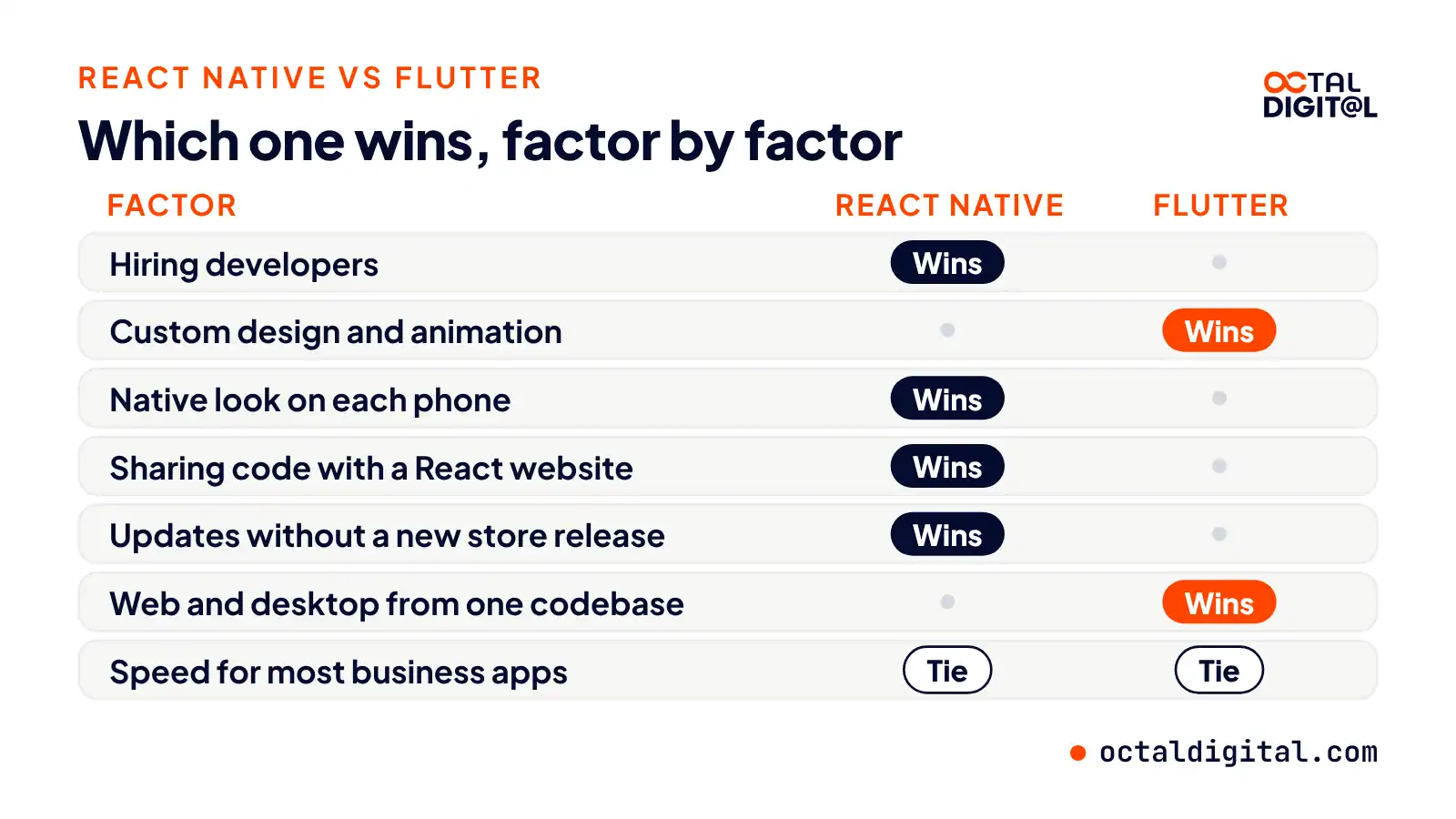
| Factor | Which one wins |
|---|---|
| Hiring developers | React Native |
| Custom design and animation | Flutter |
| Native look on each phone | React Native |
| Sharing code with a React website | React Native |
| Updates without a new store release | React Native |
| Web and desktop from one codebase | Flutter |
| Speed for most business apps | Tie |
What is React Native?
React Native is an open-source method of mobile app development for iOS and Android from one JavaScript codebase. The React Native framework allows developers to write and ship apps without the hassle of writing the same screens twice for each platform. A company that gets an app built with React Native pays for one main codebase and does not have to hire and pay for a separate iOS team and Android team, as most of the code is shared. Note that despite the shared code, real native UI components are still used but users do not need to know about them.
In the first days of smartphones, most teams that planned to build a mobile app had to write the separate code required to run on each platform, which is a slow and expensive undertaking.
Then came React Native, released by Facebook (now Meta) in 2015, where web developers who knew React could build mobile apps directly. Developers and companies who use this shared JavaScript code generally lean on its huge package library so that a feature like payments or maps usually will not need to be built from scratch for their applications. This means that a lot of the code that gets written can be reused on both platforms.
What is Flutter?
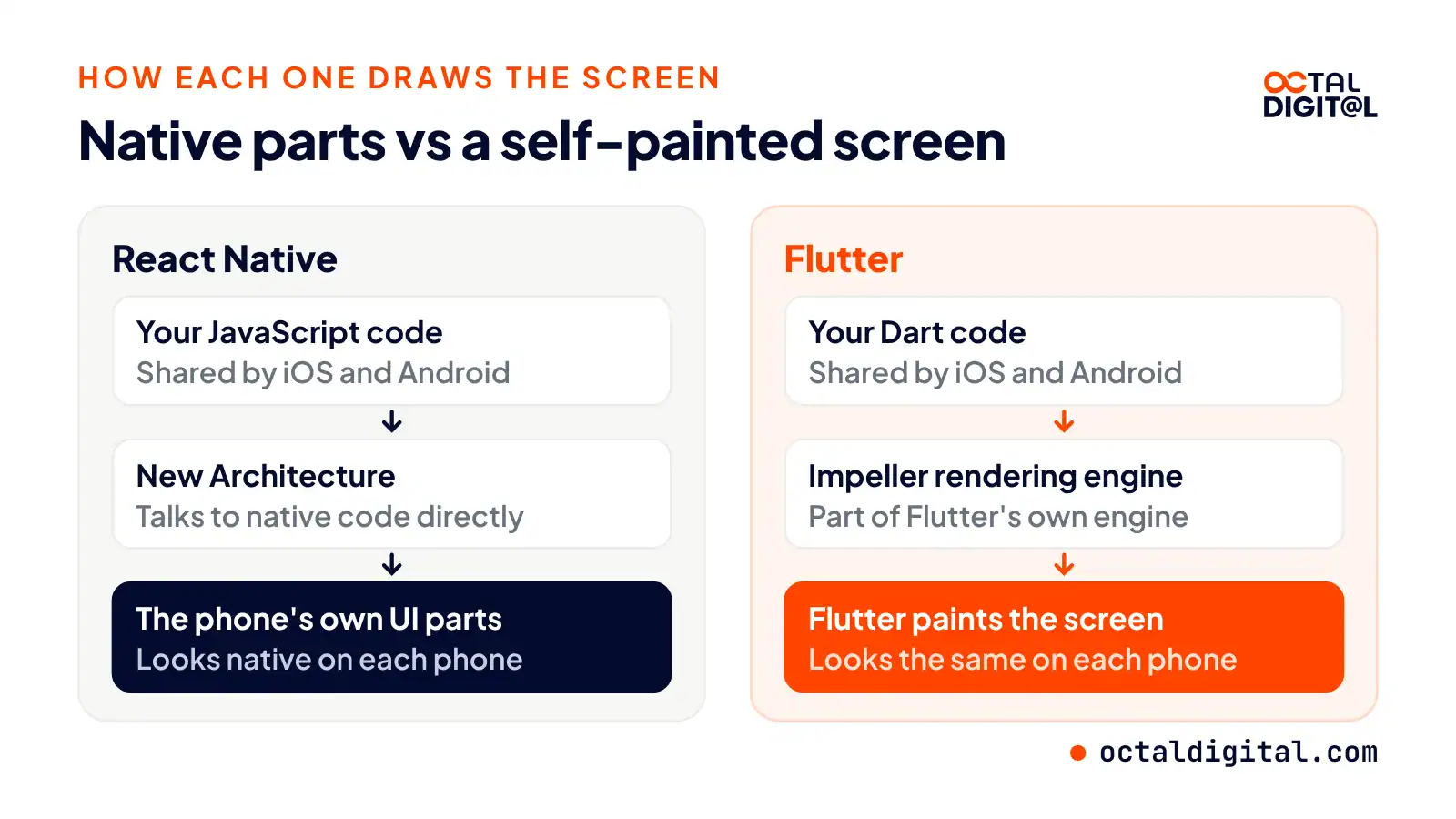
Google’s Flutter allows developers to build apps from one Dart codebase on a flexible ‘paint-it-yourself’ basis, meaning that teams only have to design the screens they use once. This is different from React Native, which hands each button to the phone’s own system, while Flutter draws nearly every pixel on the screen itself.
The term ‘cross-platform app development’ is somewhat broad, as there are still different phones running these Flutter apps, but all of the screen drawing and layout concerns are handled by Flutter’s own engine. Flutter means that the developers can get their work done without needing to think about each phone’s design system as much.
Mobile development is usually split into two areas: the frontend and the backend. The frontend is the piece of the app that users see and tap on, such as the screens and buttons. The backend is the piece that the user doesn’t see; this covers the server where the app’s data and business logic live and the database where customer accounts are kept.
How are React Native and Flutter different?
Both React Native and Flutter offer one codebase, but they’re built in different ways depending on the framework.
Platforms beyond phones
Flutter and React Native run on both iOS and Android, but Flutter’s reach goes beyond just these two systems.
As of November 2026, Flutter is available on six platforms, which was more than its first year and the year after. I think it’s fair to say that the count has held at six since Flutter 3 in 2022.
Flutter is the easy winner here since it is accessible on four more platforms than its cross-platform counterpart React Native without extra projects.
Language: JavaScript vs Dart
The main thing to weigh is how much code your team can reuse. When the Stack Overflow survey recently covered the JavaScript vs. Dart usage in terms of languages/frameworks/tools, it landed on the side that JavaScript is bigger (66% vs 5.9% in 2025).
Both React Native and Flutter give you one codebase. You’ll also get a small bit of code per platform. From the start React Native had the best web and mobile reuse, with React skills on both sides and around the same tools for each. Now though, that still holds for most teams.
Neither framework reports how much code a team shares in each app, but many share most of it. Some developers who already know typed languages move a little faster with Dart, since they were trained early on them.
In our builds, both Flutter and React Native stay about the same in speed.
For me, React Native is the plain winner here, simply because it lets web and mobile teams share one language. I firmly believe that a shared language helps all teams, so if we all share more we all gain.
Updates without a new store release
Both React Native and Flutter allow teams the option to push fixes within the app through add-ons. However, there is one big difference between both frameworks when it comes to updates.
With React Native, you have Expo’s EAS Update after the completed release to fix within the app. With Flutter, you need a third-party service to fix after the release has been completed. On its website, Shorebird offers a code push service to patch Dart code after the store release so that it can handle it for you.
I think it’s clear that React Native is the winner in this area since Expo’s service is widely used for JavaScript fixes over the air, compared to Flutter which only allows Dart fixes through Shorebird after the completed release. Native code changes still need a new store release in both.
Flutter vs React Native performance
If you don’t have a smooth screen in your app, you are not keeping users. So if you have the best features on offer, and fast screen building, it all counts for little if you don’t get speed.
Flutter tends to, in my experience, be picked by people who had rough times with React Native, or teams that prefer to work outside the “JavaScript world”. Depending on how big your app is, there may be enough heavy screens that you notice.
My winner here is a tie. Teams that have tried both Flutter and React Native often get similar speed from both, simply because both fixed their old slow spots. Many developers find animating in Flutter easier, the transitions are typically smoother, less likely to stutter, and more predictable.
But when all is said and done, those things don’t change most apps, so I have to settle on a tie as the best answer for the forms and lists most apps show.
React Native narrowed the gap in the ‘which framework runs the best’ debate, mainly when it comes to its New Architecture, on by default since version 0.76.
How each one draws the screen
Both React Native and Flutter offer building blocks, and a few of them map to each other.
There is React Native View, which is comparable to Flutter Container, and both act as a box that holds other elements, such as a card or panel, if you need a little extra layout.
There is also React Native Animated and Flutter AnimationController which offer custom motion like smooth transitions for a little more effort.
Pixel drawing is one big service that Flutter offers while React Native doesn’t. Impeller is the name of its rendering engine and it can draw text, buttons, and/or animations for you.
For that reason alone, Flutter has the edge over React Native since it gives you another way to get even more control with Flutter while React Native uses native views by design.
Tell us what your app must do and we'll recommend React Native or Flutter, with a written scope and cost range.
- A written scope and cost range
- Fixed price or hourly, your choice
- 5.0 rating from 250+ client reviews
Is Flutter better than React Native?
On paper, because Flutter compiles to native ARM code, it can be faster than React Native in animation-heavy apps. Of course, you could still build a smooth app in either one by keeping the screens simple. Or, if you’re a design-led brand, you might pick Flutter for an app if custom motion is a core part of your product.
But if you’re not either of those cases, then React Native is the choice you can expect your app’s needs to fall within. And if you want to be more specific, a clear signal for a custom designed/branded app is heavy animation on every screen for a Flutter build.
Our view is that most business apps fall within this group, though they can lean one way or the other depending on a few factors. We’ll cover these factors in a minute.
Which costs less to build, React Native or Flutter?
The biggest thing that drives the cost of your React Native or Flutter app is how complex the app is, not the framework. A simple app will sit much lower on the price scale in either one, while a more complex app will end up costing more in both. That’s because complexity takes extra time, adding developer hours and, in turn, the overall app development cost.
At Octal Digital, we build apps in both frameworks, so we can help you settle this pressing question.
After all, many Flutter apps have been built by a single developer on a laptop. And there are also React Native apps run by the largest firms worldwide, with several teams working side by side to keep an app alive.
Whether someone is building in React Native or counting on a large Flutter/Dart firm to build it for them, there’s always a cost to hiring. The hours spent finding Dart developers can be greater than the hours spent finding JavaScript ones.
This shouldn’t prevent you from choosing Flutter but act as a reminder that hiring is a serious cost. To see your app do well, you need to plan the team early and often, do your homework, and work to build something that will truly help potential users by fixing a core problem.
When you ask yourself how much a React Native or Flutter app costs, features and functions are some of the biggest things to keep in mind.
You can treat each screen you will add to your app as a small project that your app team will take on. They’ll need to work out how the screen fits into the app, decide how to code it, design an interface for it, connect it with the backend and its other screens, and so on.
For this reason, keeping your first version lean can go a long way to cutting build costs (and may help you get strong early reviews). The fewer screens you request, the lower budget your app will need at first, and more often than not, the faster your app development timeline will go.
Last of all, there are running costs of both frameworks. These are the bills that a quote might not necessarily show you early on but that you’ll end up paying for as the app grows.
Listing your app on an app store, paying for 3rd party code push like Shorebird, backend services like Firebase, and updating your app are added costs that can sneak up when you aren’t expecting them. When choosing a framework, ask about these kinds of costs to get a truer answer to the question, “Which is cheaper, React Native or Flutter?”
Our US-based team builds cross-platform apps at $25 to $50 an hour, on a fixed price or hourly.
Which is more popular, React Native or Flutter?
Reported numbers for two frameworks you definitely know: Flutter was used by 9.4% of developers in the Stack Overflow 2024 survey, React Native was used by 8.4%, Google Pay picked Flutter for its global app, and Microsoft runs React Native in over 40 Office experiences. These are survey and company figures, so they aren’t exact. Still, from what we see, they give a fair picture.
React Native is one of the best-known frameworks in the world, and it’s earned that popularity with a fairly familiar language. It’s a great example of a tool that brings a web team’s skills to mobile with good docs and support.
When it comes to Flutter, the growth shows in the numbers. The language is niche, while the developer count that goes into it is large and sizable in surveys.
React Native or Flutter: which fits your business?
Now that you have a sense of the costs that go into building your app, let’s look at your options when picking an app framework. After all, there are many kinds of business apps, each with its own users, features, and pros and cons to weigh.
| App type | Our pick |
|---|---|
| Online store | React Native |
| Booking app | React Native |
| MVP to test an idea | React Native |
| Team already uses React | React Native |
| Fintech or banking app | Either |
| Healthcare app | Either |
| Brand app with heavy animation | Flutter |
| One app for phones, web and desktop | Flutter |
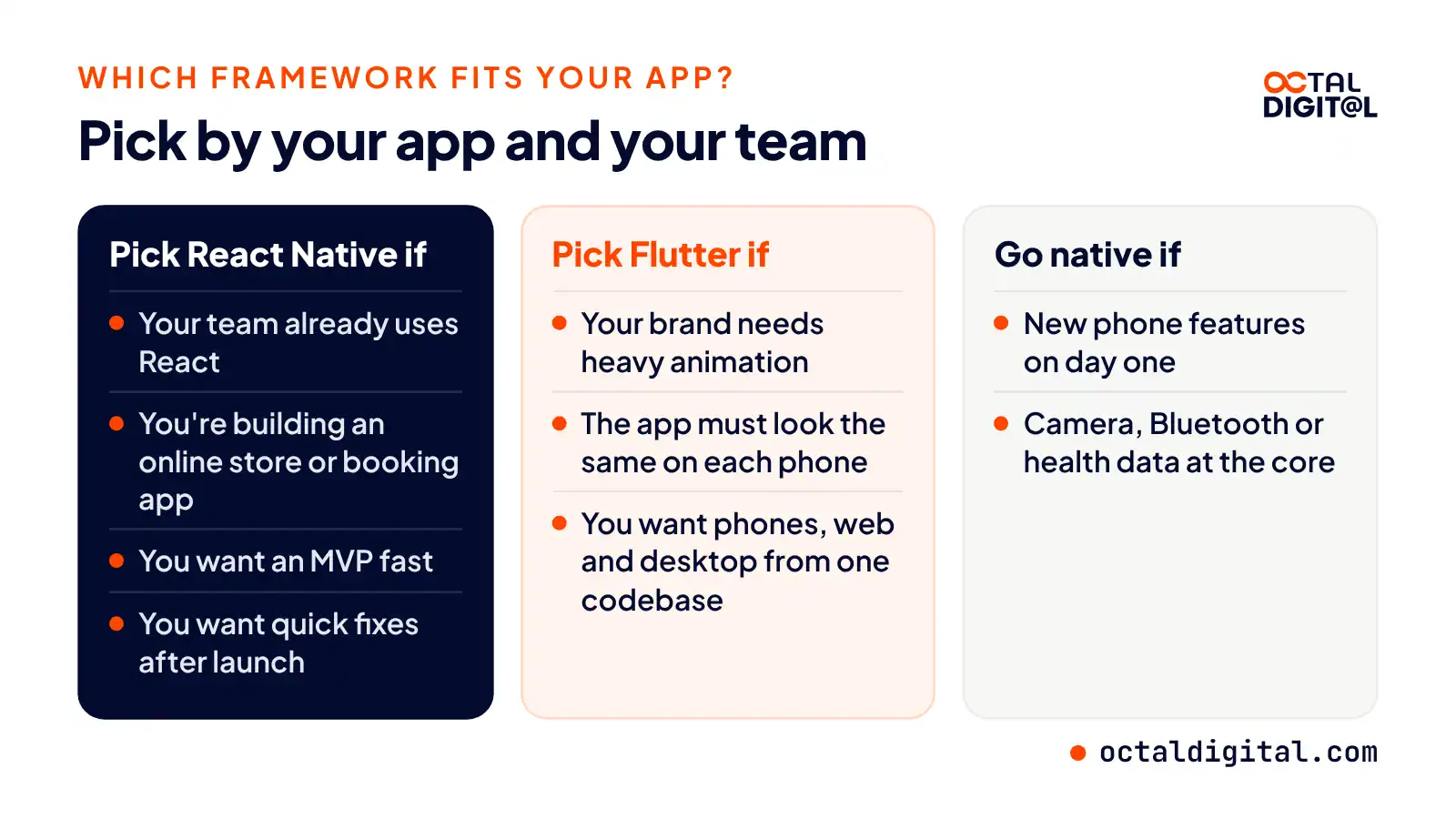
The first path you can take when building mobile app products is choosing React Native. At first look, this might seem like the safe way to go. After all, you’ll have more developers to pick from for your app. You can reuse the React talent building your website and keep more control over the cost.
If these benefits matter to you, this might be the right way to go for an online store, a booking tool or an MVP. However, it’s worth noting that this route has some challenges.
Matching one custom look on each phone might be trickier than you anticipate. The average app doesn’t need pixel-perfect design across phones, let alone the custom motion a brand app needs along the way.
That’s why the second option, Flutter, is so common. It doesn’t require you to match each phone but rather paint one design across many screen sizes.
Choosing Flutter to handle a design-heavy app can be a strong option for fintech, fitness and brand apps. This is known as a custom UI build.
Hiring Dart developers can be (and often is) a slower job.
What about native or Kotlin Multiplatform?
Working with fully native code is another common option. This is when you use Swift for a native iOS app and Kotlin for Android to build your app. This has a few benefits, provided you know how to budget for the second codebase.
Native usually refers to working with code in languages quite far from the web, potentially spanning two separate teams. One of the main benefits of going this route is that it’s more reliable to work with new phone features on day one than through plugins, which can be ideal if you have an app that leans on the camera, Bluetooth or health data.
Another variation of native development is Kotlin Multiplatform or sharing a business logic layer written in Kotlin with native screens on top. Kotlin Multiplatform also tends to have the benefit of letting Android app development teams and iOS teams share code.
Cross-platform and native development is what we offer at Octal Digital with our US-based team and full build options. Our teams in Houston, Dallas and Los Angeles make us a strong fit for companies across the United States thanks to US time zones and working hours.
How we choose at Octal Digital
We choose the framework of an app based on the kind of product you need. A new product build means picking from scratch, while an existing app carries code you’ve already started, and the two lead to different framework choices. Throughout this guide, we’ve covered general trade-offs and picks based on official docs and surveys. However, we haven’t been too specific, as every team will have their own skills and habits.
We can share how we decide here at Octal Digital. So, before wrapping up this post, here’s a short breakdown of how we choose the framework in our app development process.
Generally, you can plan to start from $15,000 in an Octal Digital app development project, at $25 to $50 an hour. It could be more, based on which type of build you need:
New app: This is the route you’ll choose here at Octal Digital if you need an app made from scratch. You have no code written, only some ideas for your app’s look and features. For this, we look at your team, your design and your platforms before we pick React Native or Flutter.
Existing app: An existing codebase is great when you’ve already made some headway with your app and want help to grow it. For this, we usually keep the framework you have, depending on its health and how complex your project is.
As you can see, plenty goes into the question, “Should my app use React Native or Flutter?”
One thing we’re sure of, though, is that the team matters more than the framework. If you’re looking for a clear answer and an app that meets your goals and expectations, we’re ready to help! Get in touch with the team at Octal Digital today and tell us about your idea!
Launch the core features on iOS and Android first, then grow from real user feedback.
- A written scope and cost range
- Fixed price or hourly, your choice
- 5.0 rating from 250+ client reviews
Is React Native or Flutter still worth it in 2026?
One of the final questions you’ll want to keep in mind when choosing a framework is the future of each one. After all, a framework is never truly “finished.” And it’s surely not finished right after a big release. That’s when new phones, new OS versions, and other changes pour in.
Fortunately, picking either framework isn’t nearly as risky as it was, though it is a long-term bet to consider. And it’s one of the many reasons that React Native (backed by Meta) and Flutter (backed by Google) are still worth it in 2026.
FAQs
Is React Native or Flutter better for an MVP?
After building with both app frameworks, we’ve found that React Native is the better choice for MVPs based on hiring and speed. Hiring tends to be easier with React Native. Others have said that the build is slightly faster with Flutter widgets, but we haven’t noticed such a difference.
The build time is very similar between the two, with the main difference being that React Native is usually easier to staff than Flutter.
Can Flutter apps use native phone features?
Flutter does not use native buttons for its screens. However, it does have a plugin system, and developers can get the camera whenever they add a plugin from pub.dev, Dart’s package site.
Do Flutter and React Native apps feel different to users?
React Native and Flutter users do not get different installs. Since you’re downloading a normal app binary, the stores will list them as an app like any other for download purposes.
Is Flutter hard to learn for a JavaScript team?
According to Google, the Flutter team offers the bonus of a free codelab library for new developers, with a full Dart tour on dart.dev. Flutter gives you fast hot reload on most code changes in your app, with fewer restarts.
Flutter vs Swift or Kotlin: when is native better?
Does Flutter or React Native get new phone features first? To date, neither framework has got new iOS features first, and native Swift and Kotlin still get them on day one through Apple’s and Google’s own SDKs! This is a big deal and heavily tips our decision in favor of native for feature-heavy apps.
Can you switch from React Native to Flutter later?
There is no specific ‘React Native to Flutter’ converter around, at least not one that’s ready for real apps. In the debate between Flutter vs. React Native, which framework is a better place for a switch? The Flutter guide for React Native developers maps concepts by hand, so neither switch is automatic… however, your backend, APIs and designs can stay the same.
Both frameworks have a way to go before a switch feels truly easy, but your backend has made part of the move already.
Have a project in mind? Get a free consultation.
Tell us what you want to build. We reply with next steps, a rough timeline and a cost range.
(800) 995-3369
Matthew Jones supports Octal Digital as a Digital Strategist and trusted technology advisor, helping guide clients through scalable solutions, emerging tools, and smart development strategies that align with business goals and growth.